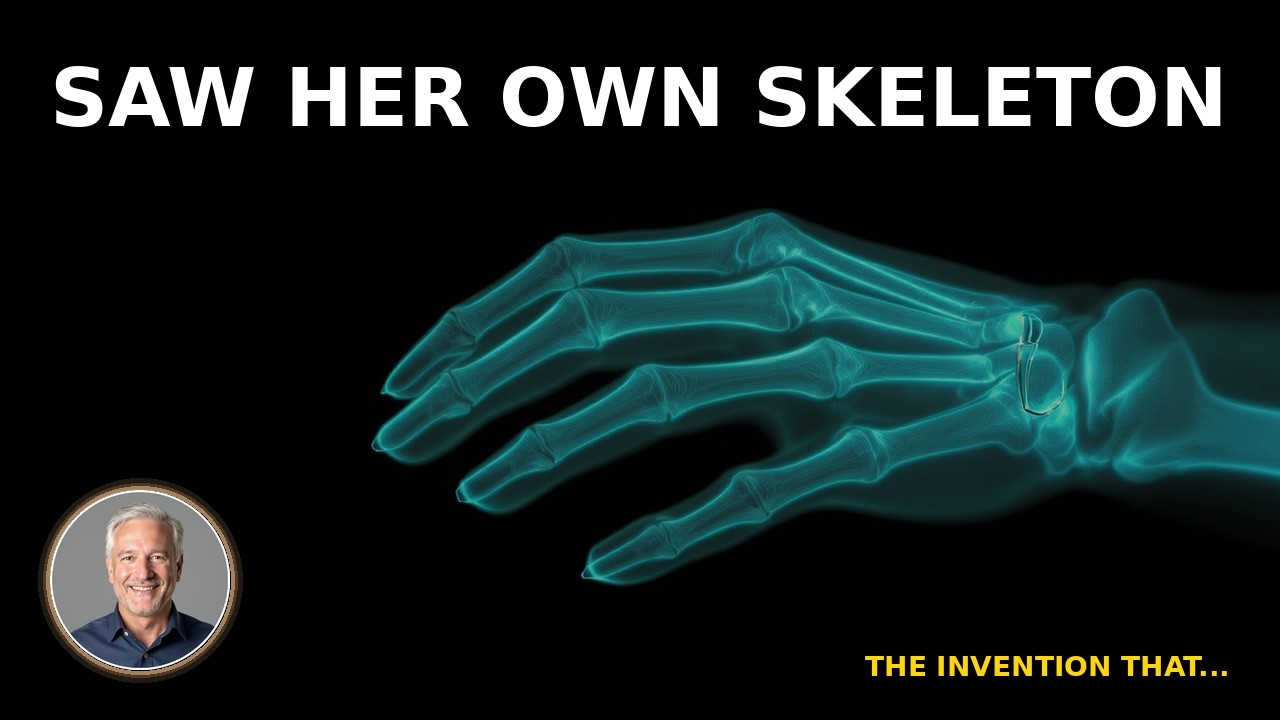
Anna Bertha Röntgen occupies a unique place in scientific history—not as a researcher or inventor, but as the unwitting subject of one of the most revolutionary discoveries of the modern age. On November 8, 1895, when she placed her hand on her husband Wilhelm’s photographic plate, she became the first human being ever to see inside her own living body without surgical intervention. Her skeletal hand, wedding ring floating eerily around her finger bone, marked the birth of medical imaging and forever changed how we understand the human body.
The Woman Behind the Discovery
Born Anna Bertha Ludwig in 1839, she married Wilhelm Röntgen in 1872, becoming his steadfast companion through decades of scientific work. For six weeks in late 1895, she watched her husband disappear into his laboratory at the University of Würzburg, emerging only briefly for meals, consumed by a mysterious discovery he refused to discuss. Wilhelm had stumbled upon what he called “X-rays” while experimenting with cathode ray tubes, but he needed proof that these invisible rays could penetrate human tissue.
When Wilhelm finally revealed his work to Anna Bertha, her reaction was immediate and visceral. Upon seeing the ghostly image of her hand—flesh rendered transparent, bones starkly visible—she reportedly exclaimed, “I have seen my death!” Her words proved prophetic of the profound psychological impact X-rays would have on human consciousness. For the first time in history, people could confront their own mortality by gazing upon their skeletons while still alive.
The First Medical Image Changes Everything
Anna Bertha’s hand photograph, taken on December 22, 1895, became the world’s first medical X-ray image. The 15-minute exposure captured not just bones and her wedding ring, but the dawn of diagnostic medicine. Within months of Wilhelm’s announcement to the Würzburg Physical-Medical Society on January 23, 1896, X-ray machines appeared in hospitals across Europe and America. Doctors could suddenly diagnose broken bones, locate bullets, and identify diseases without cutting open their patients.
The image’s impact extended far beyond medicine. Anna Bertha’s skeletal hand appeared in newspapers worldwide, simultaneously fascinating and terrifying the public. The photograph challenged fundamental assumptions about privacy, intimacy, and the boundaries between inner and outer self. Victorian society, obsessed with propriety and concealment, suddenly faced technology that could see through clothing and flesh alike.
Her experience also highlighted the democratizing potential of scientific discovery. Unlike many breakthrough moments confined to academic circles, Anna Bertha’s X-ray spoke to universal human concerns about health, mortality, and the mystery of our own bodies. Every person could imagine themselves in her position, hand pressed against the plate, waiting to see inside themselves.
A Legacy Written in Light and Shadow
Anna Bertha Röntgen died in 1919, having lived to see X-rays transform from laboratory curiosity to indispensable medical tool. Her willingness to participate in Wilhelm’s experiment—trusting him despite not understanding the implications—enabled one of medicine’s greatest advances. Today, billions of X-rays are taken annually worldwide, each one tracing its lineage back to that first image of her hand.
Her story also serves as a reminder that scientific breakthroughs often require not just brilliant researchers, but brave individuals willing to step into the unknown. Anna Bertha couldn’t have known that her moment of trust would help establish radiology, enable countless medical diagnoses, and save millions of lives. She simply placed her hand where her husband asked, and in doing so, helped illuminate the hidden architecture of human existence.