Corporate Autopsy: Business Collapses Explained
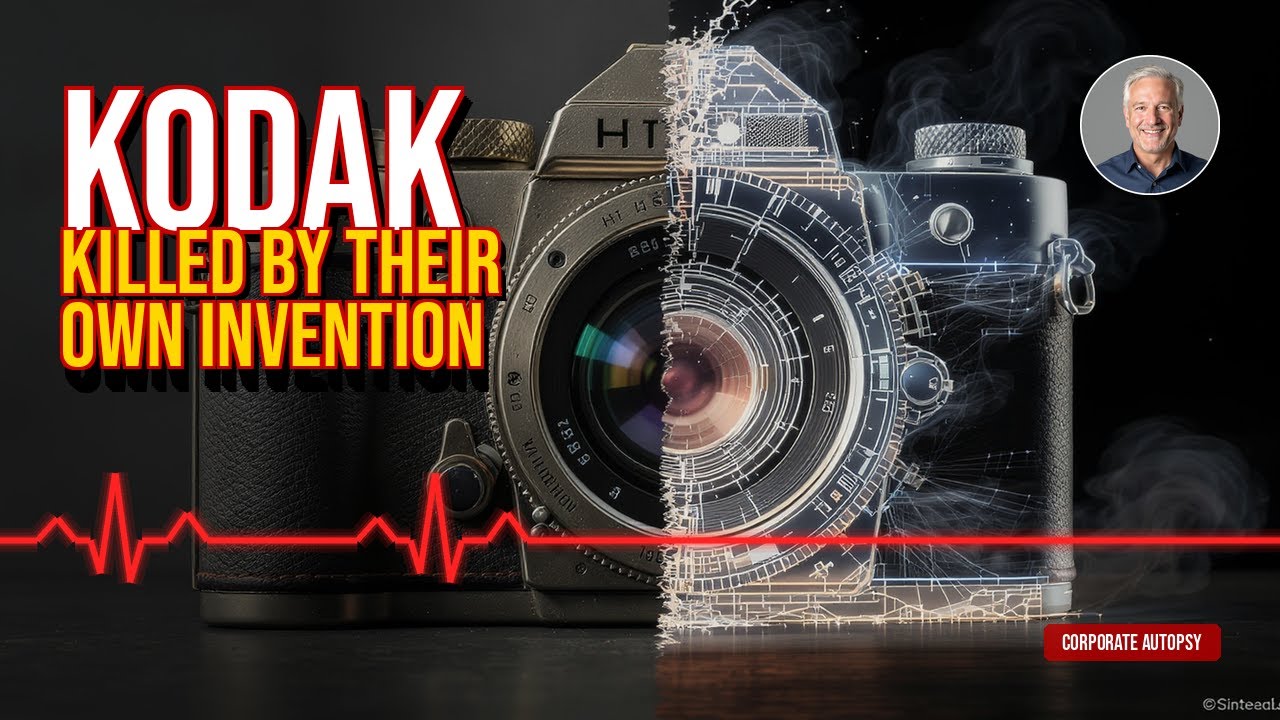
Kodak: They Invented Digital Photography, Then Died From It
Steve Sasson built the first digital camera at Kodak in 1975 and his bosses told him to keep it quiet
Kodak CEO during company's bankruptcy
1945-present
Appears in 1 documentary
Antonio Perez arrived at Kodak in 2003 as the company’s savior, a seasoned Hewlett-Packard executive tasked with steering the 124-year-old photography giant through the digital revolution. Instead, he became the face of one of corporate America’s most spectacular failures, presiding over Kodak’s 2012 bankruptcy filing—a collapse that transformed him from turnaround specialist into a cautionary tale about the perils of disruption.
When Perez took the helm as CEO in 2005, Kodak faced an existential crisis that had been decades in the making. The company had invented digital photography in 1975 but systematically buried the technology to protect its lucrative film business. By the time Perez arrived, digital cameras were already commoditizing, and smartphones were on the horizon. His strategy seemed logical on paper: pivot Kodak from a film company into a digital imaging powerhouse, leveraging the company’s vast patent portfolio and brand recognition.
Perez pursued an aggressive transformation plan, acquiring companies like Creo and Versamark to build capabilities in commercial printing and digital services. He invested heavily in inkjet printers for home consumers and digital printing systems for businesses. The strategy burned through cash—Kodak spent over $3 billion on acquisitions and R&D between 2004 and 2011—while revenues continued their relentless decline from $14.3 billion in 2005 to $6.2 billion by 2011.
The fundamental problem wasn’t Perez’s vision but the mathematical impossibility of his task. Kodak’s film business had generated gross margins of 70% or higher, while digital products typically delivered margins of 20% or less. To replace every dollar of film revenue, Kodak would need to generate three to four dollars in digital sales—a near-impossible feat in commoditizing markets where competitors like Canon, HP, and emerging smartphone manufacturers held structural advantages.
On January 19, 2012, Perez filed for Chapter 11 bankruptcy protection, ending Kodak’s 132-year run as an independent company. The filing came despite years of asset sales, workforce reductions from 145,000 employees in 1988 to fewer than 17,000 by 2012, and desperate attempts to monetize Kodak’s intellectual property. Perez had managed to extract some value from the company’s patent portfolio, ultimately generating over $3 billion in licensing revenue, but it wasn’t enough to overcome the structural decline.
The bankruptcy highlighted a broader pattern in American business: the difficulty established companies face when technological disruption attacks their core profit engines. Perez wasn’t incompetent—he was executing a reasonable strategy against impossible odds. Clayton Christensen’s “Innovator’s Dilemma” had predicted exactly this scenario: profitable companies struggle to cannibalize their own high-margin businesses, even when they possess the disruptive technology.
Perez’s tenure demonstrates why technical innovation alone doesn’t guarantee survival. Kodak had the patents, the engineers, and the early-mover advantage in digital photography. What it lacked was the organizational willingness to destroy its existing business model fast enough to build a new one. By the time Perez arrived, the window for managed transition had largely closed.
Antonio Perez’s story transcends individual leadership failure to illuminate the brutal mathematics of disruption. His eight-year battle to save Kodak serves as a masterclass in why even brilliant executives struggle when entire industries shift beneath their feet. Today, business schools teach the “Kodak moment” as shorthand for companies that fail to adapt, but Perez’s experience reveals a more nuanced truth: sometimes the best-laid transformation plans cannot overcome the structural forces of technological change.
His legacy lives on in every established company grappling with digital disruption, from retail to automotive to media. The Perez era at Kodak reminds us that in the face of true disruption, evolution isn’t always possible—sometimes, extinction is inevitable, regardless of who’s at the helm.
Christensen's framework perfectly explains why Perez faced an nearly impossible task trying to transform Kodak's high-margin film business.
Collins' five stages of decline map precisely onto Kodak's trajectory under Perez, showing how even good decisions can't always prevent corporate death.
The definitive account of Kodak's collapse, with extensive coverage of Perez's transformation strategy and why it ultimately failed.
Steve Sasson built the first digital camera at Kodak in 1975 and his bosses told him to keep it quiet