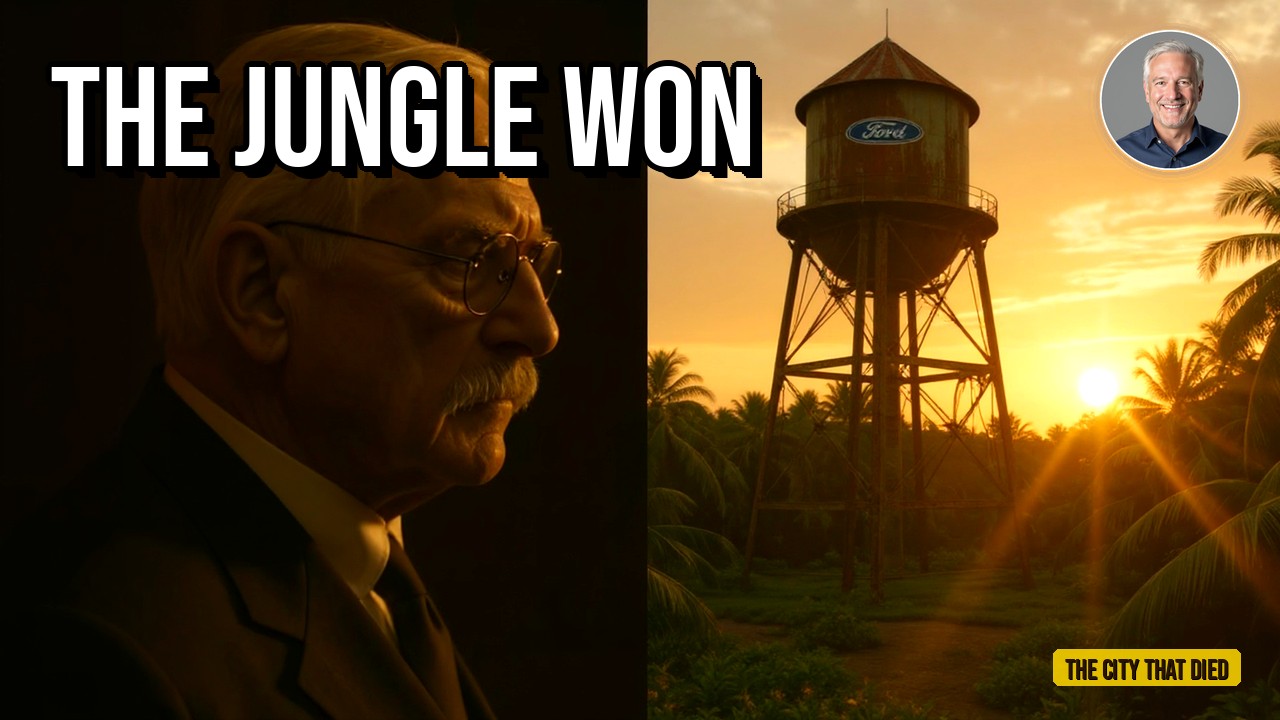
Archibald Johnston represented the collision between American industrial ambition and Brazilian reality in one of the 20th century’s most audacious corporate experiments. As Ford Motor Company’s manager at Fordlandia, the rubber plantation carved from the Amazon rainforest, Johnston embodied the paternalistic vision that ultimately sparked one of the most dramatic labor revolts in industrial history.
The American Overseer in the Amazon
Johnston arrived in Brazil in the late 1920s as part of Henry Ford’s grand vision to create a self-sufficient rubber supply for his automobile empire. Ford had purchased 2.5 million acres of Amazon rainforest in 1927, determined to build not just a plantation but an entire American-style community complete with suburban homes, a golf course, and strict moral codes. Johnston, like other American managers sent to oversee this venture, carried with him the unwavering belief that American methods and values could transform the jungle into a productive industrial outpost.
The Fordlandia project represented more than just rubber cultivation—it was an exercise in cultural imperialism. Johnston and his fellow managers enforced a rigid system that banned alcohol, prohibited traditional Brazilian foods in favor of bland American fare, and required workers to attend mandatory square dancing lessons and poetry readings. These weren’t merely corporate policies but deliberate attempts to reshape Brazilian workers into Ford’s idealized American laborers. Johnston supervised a regime where traditional work patterns, local customs, and even dietary preferences were systematically suppressed in favor of Detroit’s vision of proper industrial life.
The December 1930 Uprising
The tensions Johnston helped create exploded on December 20, 1930, when Brazilian workers finally revolted against the suffocating American management system. The uprising began in the dining hall when workers refused to eat the mandated American meals, but quickly escalated into something far more significant. Within hours, hundreds of workers were smashing machinery, overturning company vehicles, and pursuing American managers—including Johnston—through the jungle with machetes and other weapons.
Johnston’s experience during those terrifying hours illustrated the complete failure of Ford’s paternalistic approach. The very workers he had been tasked to “civilize” were now hunting him through the rainforest, their anger fueled not just by poor working conditions but by months of cultural humiliation and forced Americanization. The revolt lasted several days, with Brazilian authorities eventually restoring order, but the damage to Ford’s Amazon dream was irreversible.
Legacy of Cultural Collision
Johnston’s story reveals the broader pattern of American corporate expansion in Latin America during the early 20th century. His role at Fordlandia exemplified how American companies often approached foreign ventures with a toxic combination of technological confidence and cultural arrogance. The assumption that American industrial methods could simply be transplanted anywhere, regardless of local conditions or customs, proved disastrously wrong in the Amazon’s unforgiving environment.
The failure Johnston witnessed at Fordlandia foreshadowed similar clashes between American corporate culture and local realities throughout the developing world. His experience managing Brazilian workers under Ford’s rigid cultural mandates demonstrates why so many well-funded American projects abroad collapsed not due to technical limitations but because of fundamental misunderstandings about human nature and cultural difference. Ford eventually abandoned Fordlandia in 1945, selling the entire operation back to Brazil for a fraction of its investment—a testament to the kind of cultural blindness Johnston had helped enforce in the jungle.