Corporate Autopsy: Business Collapses Explained
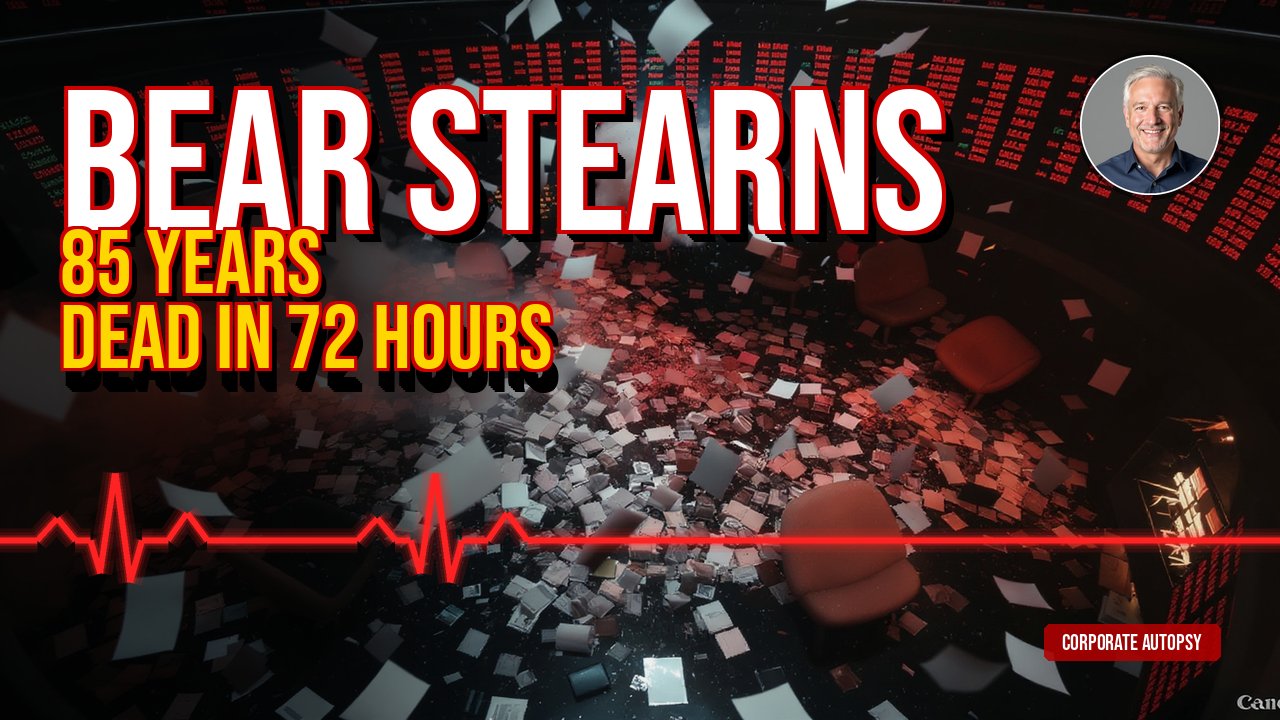
Bear Stearns: 85 Years Destroyed in 72 Hours
While Bear Stearns was collapsing, CEO Jimmy Cayne was at a bridge tournament in Detroit, unreachable by phone
Federal Reserve Chairman during 2008 financial crisis
Appears in 1 documentary
When the American financial system began its spectacular collapse in 2008, one man found himself at the center of the most dangerous economic crisis since the Great Depression. Ben Bernanke, the soft-spoken former Princeton economics professor who had become Chairman of the Federal Reserve just two years earlier, would orchestrate an unprecedented intervention that likely prevented a complete meltdown of the global economy.
Born in Augusta, Georgia, in 1953, Benjamin Shalom Bernanke seemed destined for a life of academic obscurity rather than Wall Street drama. After earning his PhD in economics from MIT in 1979, he spent two decades as a respected but relatively unknown scholar at Stanford and Princeton, specializing in the economics of the Great Depression—knowledge that would prove prophetic.
Bernanke’s academic work focused on understanding how financial panics could amplify economic downturns, making him one of the few economists who truly grasped the systemic risks building in the American financial system. His 1995 paper “Inside the Black Box” examined how monetary policy actually worked, while his Depression-era research revealed how banking failures could trigger deflationary spirals. This expertise caught the attention of policymakers, leading to his appointment to the Federal Reserve Board of Governors in 2002 and his elevation to Chairman in 2006, just as housing prices began their ominous peak.
When Bear Stearns collapsed in March 2008—destroyed in just 72 hours as panic spread through the investment banking world—Bernanke faced his first major test. Unlike his predecessor Alan Greenspan, who had cultivated an almost mystical public persona, Bernanke approached the crisis with professorial precision and unprecedented transparency. He orchestrated the Fed’s first emergency lending to an investment bank since the 1930s, facilitating JPMorgan Chase’s acquisition of Bear Stearns for the fire-sale price of $10 per share.
But Bear Stearns was merely the opening act. Over the following months, Bernanke would deploy every tool in the Fed’s arsenal—and invent several new ones. When Lehman Brothers collapsed that September, triggering a global freeze in credit markets, Bernanke launched quantitative easing, purchasing trillions of dollars in government bonds to inject liquidity into the financial system. He slashed interest rates to near zero and kept them there for years, fundamentally changing how central banks respond to financial crises.
The numbers tell the story of Bernanke’s extraordinary intervention: the Fed’s balance sheet expanded from $870 billion in 2007 to over $4 trillion by the time he left office in 2014. His policies prevented the unemployment rate from reaching Depression-era levels, though it still peaked at 10 percent in 2009.
Bernanke’s crisis management established the template for 21st-century central banking. His willingness to experiment with unconventional monetary policy—once considered radical—became orthodox doctrine, adopted by central banks worldwide. The European Central Bank, Bank of Japan, and Bank of England all followed his quantitative easing playbook during subsequent crises, including the COVID-19 pandemic.
Yet Bernanke’s legacy remains complex. Critics argue his ultra-low interest rates inflated new asset bubbles and increased inequality by boosting stock prices while leaving wages stagnant. His defenders counter that without his intervention, America would have experienced a deflationary collapse rivaling the 1930s. What’s undeniable is that Bernanke transformed central banking from a relatively predictable, behind-the-scenes operation into the primary tool for managing modern financial crises.
In 2022, Bernanke received the Nobel Prize in Economic Sciences, recognition that his academic insights about financial panics had proven devastatingly accurate—and that his real-world application of those theories had helped save the global economy.
Bernanke features prominently as the key decision-maker during the 2008 crisis, showing his evolution from academic to crisis manager.
Bernanke's own memoir of the financial crisis, offering unprecedented insider perspective on the Fed's emergency response.
Essential background on the Federal Reserve system that Bernanke transformed during the crisis years.
While Bear Stearns was collapsing, CEO Jimmy Cayne was at a bridge tournament in Detroit, unreachable by phone