Corporate Autopsy: Business Collapses Explained
Toys R Us: How Private Equity Killed the Toy Giant
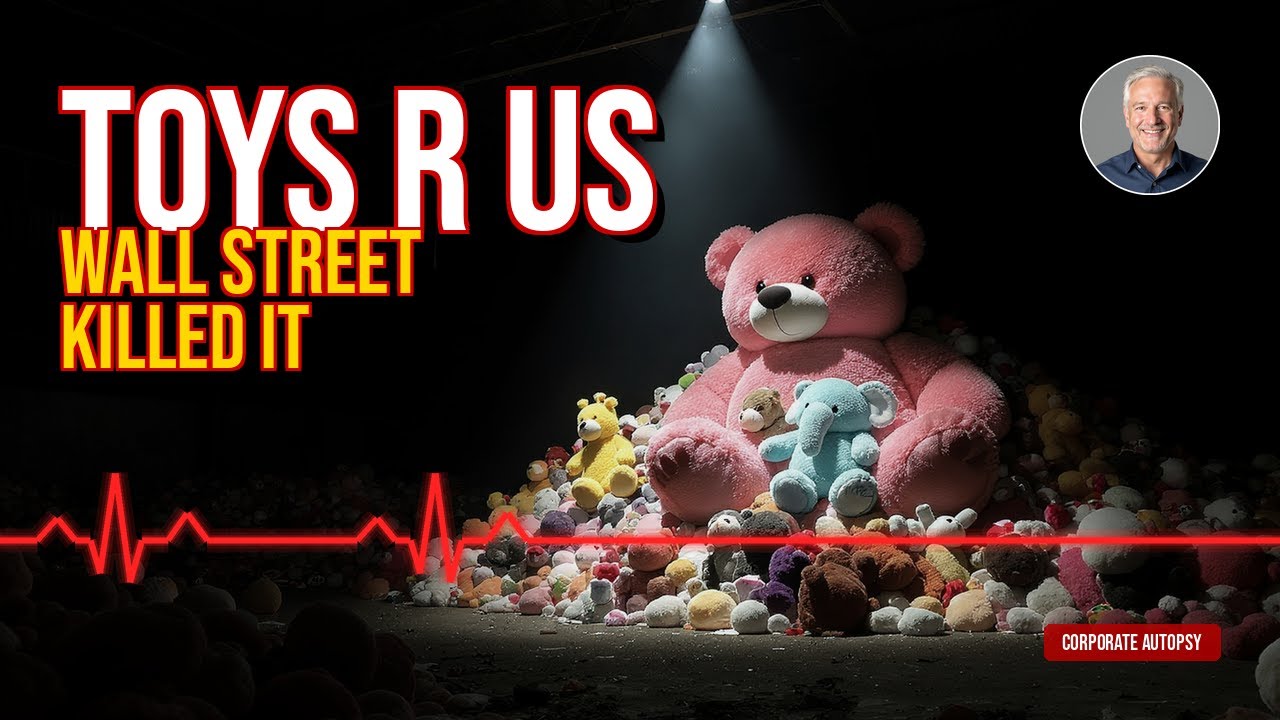
Toys R Us paid $400 million per year in interest on debt forced on them by the buyout firms
Founder of Toys"R"Us
1923-2018
Appears in 1 documentary
Charles Lazarus built the retail empire that defined childhood for millions of Americans, only to watch it crumble under the weight of financial engineering decades after his departure. His story embodies both the entrepreneurial spirit of post-war America and the destructive power of modern private equity.
Born in 1923 to a family running a bicycle repair shop in Washington D.C., Lazarus demonstrated business acumen early. After serving in World War II, he took over his father’s struggling shop in 1948 and pivoted to baby furniture—reasoning that the post-war baby boom represented unprecedented opportunity. His $2,000 investment in Children’s Bargain Town proved prescient as young families flocked to his supermarket-style approach to baby goods.
The breakthrough came in the 1950s when customers consistently asked for toys alongside furniture. Lazarus recognized that toys offered better margins and year-round demand compared to seasonal baby furniture. In 1957, he opened the first dedicated Toys"R"Us store in Rockville, Maryland, pioneering the toy superstore concept. The formula was revolutionary: vast warehouse-style spaces stocked with every conceivable toy at competitive prices, eliminating the limitations of traditional department store toy sections.
Lazarus understood that toys represented more than mere products—they were childhood dreams made tangible. His stores became wonderlands where children could see the full universe of available toys under one roof. By going public in 1978, Toys"R"Us had grown to 120 stores with $325 million in annual revenue. The company’s expansion accelerated through the 1980s and 1990s, reaching over 1,500 locations worldwide at its peak.
The secret lay in Lazarus’s grasp of retail fundamentals that would later be forgotten. He negotiated directly with manufacturers, achieving economies of scale impossible for smaller competitors. His “pile it high, sell it cheap” philosophy created a self-reinforcing cycle: lower prices drove higher volumes, which enabled even better wholesale terms. Toys"R"Us became so dominant that toy manufacturers designed their production cycles around the retailer’s buying patterns.
Lazarus also grasped the psychological dimensions of toy retail. The backwards “R” in the logo suggested a child’s handwriting, while Geoffrey the Giraffe mascot made the vast warehouses feel friendly rather than intimidating. Store layouts were designed to encourage exploration, with popular items strategically placed to drive foot traffic past impulse purchases.
Lazarus stepped down as CEO in 1994, though he remained chairman until 1998. His departure coincided with the rise of internet retail and big-box competitors like Walmart, but Toys"R"Us initially weathered these challenges. The company maintained profitability and market leadership through the early 2000s.
The fatal blow came in 2005, two years before Lazarus’s death, when private equity firms Bain Capital and KKR acquired Toys"R"Us for $6.6 billion in a leveraged buyout. The acquisition saddled the company with $5 billion in debt, forcing annual interest payments of $400 million—money that should have funded e-commerce development and store modernization. Unable to adapt to changing retail patterns while servicing crushing debt loads, Toys"R"Us filed for bankruptcy in 2017 and liquidated in 2018.
Lazarus lived to see the beginning of his creation’s end, dying in March 2018 just as the final store closures were announced. His legacy represents both entrepreneurial triumph and a cautionary tale about financial engineering. He created something genuinely valuable—a retail experience that brought joy to countless families—only to see it destroyed not by market forces or consumer preferences, but by the mathematics of leveraged debt. The rise and fall of Toys"R"Us illustrates how even the most successful businesses can be vulnerable to financial manipulation that prioritizes short-term extraction over long-term value creation.
The definitive account of leveraged buyout tactics that would later destroy Lazarus's retail empire. Essential for understanding how private equity dismantled Toys"R"Us.
Explains why Lazarus's successful big-box model couldn't adapt to e-commerce disruption. The Toys"R"Us decline follows Christensen's patterns precisely.
Chronicles how Amazon's rise challenged Lazarus's physical retail empire. Shows the competitive pressures Toys"R"Us faced while burdened with private equity debt.
Toys R Us paid $400 million per year in interest on debt forced on them by the buyout firms