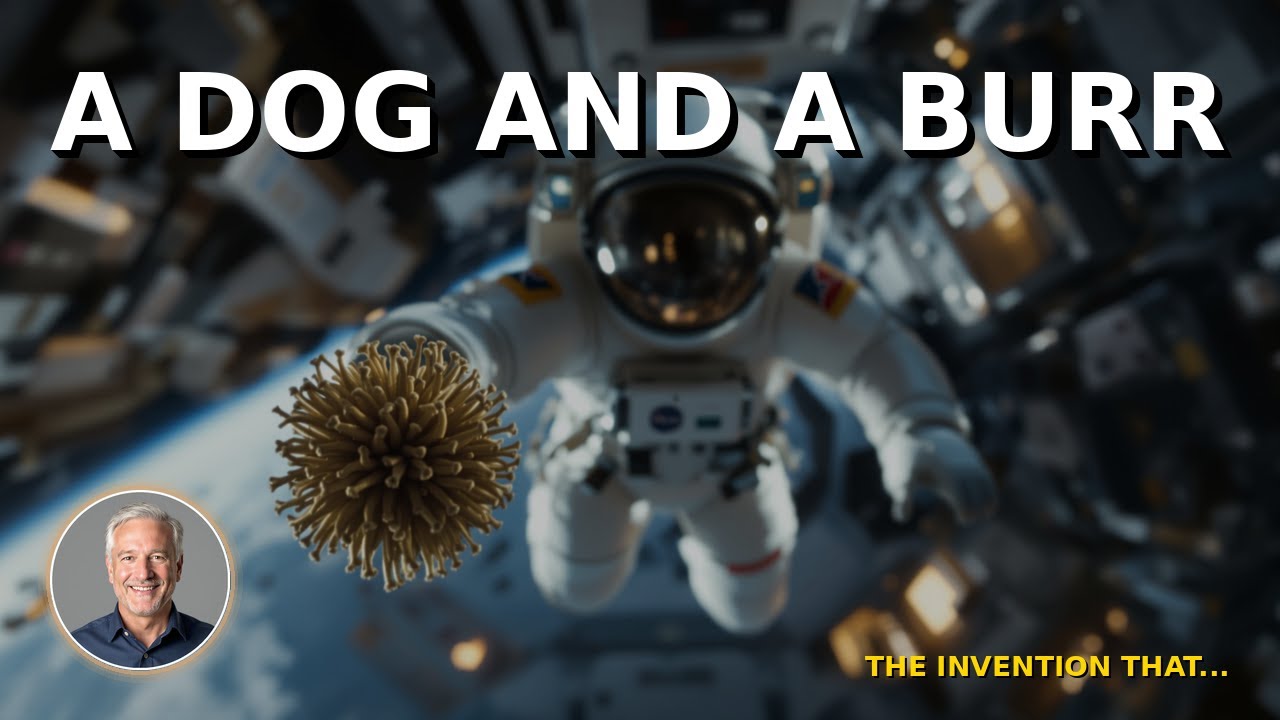
George de Mestral never intended to change the world when he returned from a hunting trip in the Swiss Alps in 1941, picking burrs off his dog’s fur. But that moment of curiosity—examining the tiny hooks under a microscope instead of simply discarding the annoying seeds—would eventually put his invention on the Moon and throughout the International Space Station.
The Patient Inventor
Born in 1907 in Colombier, Switzerland, de Mestral was already an accomplished electrical engineer when nature provided him with his greatest inspiration. The burdock burr’s microscopic hooks, designed by evolution to catch onto animal fur for seed dispersal, revealed a simple yet revolutionary fastening principle. While others saw only a nuisance, de Mestral recognized a solution to humanity’s ancient challenge of joining materials together.
The path from observation to invention proved far more difficult than the initial insight. De Mestral spent eight years experimenting with different materials and manufacturing techniques. Cotton proved too weak, but nylon—a relatively new synthetic material—offered the durability and flexibility he needed. Working with a weaver in Lyon, France, he developed a process to create two complementary strips: one covered in tiny hooks, the other in soft loops that the hooks could grab.
By 1955, de Mestral had secured patents in multiple countries for what he called “Velcro,” combining the French words “velours” (velvet) and “crochet” (hook). His timing seemed perfect—the post-war world was hungry for innovations that could simplify daily life.
From Rejection to Revolution
The fashion industry’s response was swift and brutal. Every major clothing manufacturer rejected Velcro as aesthetically unacceptable. The ripping sound it made when separated seemed harsh and mechanical. Its utilitarian appearance clashed with the era’s emphasis on elegance and refinement. For years, de Mestral’s revolutionary fastener found only niche applications in industrial settings.
Everything changed when NASA discovered Velcro in the early 1960s. The space program needed fasteners that could work in zero gravity, where traditional methods like zippers and buttons became clumsy obstacles inside bulky spacesuits. Velcro’s ability to provide secure, easily adjustable connections made it indispensable for the Apollo missions. Astronauts used it to secure tools, food packages, and equipment inside their spacecraft.
This endorsement from humanity’s most advanced technological endeavor transformed Velcro’s reputation overnight. What had once seemed crude and unappealing now appeared cutting-edge and futuristic. The same fastener that fashion houses had dismissed as too ugly for clothing was sophisticated enough for Moon landings.
Legacy of Biomimicry
De Mestral’s story represents more than just one successful invention—it exemplifies the power of biomimicry decades before scientists coined that term. His willingness to learn from nature’s engineering solutions anticipated a fundamental shift in how humans approach technological challenges. Today, researchers routinely study everything from gecko feet to shark skin, seeking innovations hiding in plain sight.
The numbers speak to Velcro’s enduring impact: over ten thousand strips now hold the International Space Station together, while millions of products worldwide rely on hook-and-loop fasteners. From children’s shoes to medical devices, de Mestral’s observation has touched virtually every aspect of modern life.
When de Mestral died in 1990, his invention had generated hundreds of millions in revenue and spawned an entire industry of imitators and improvements. More importantly, his approach—patient observation of natural phenomena followed by years of methodical development—became a template for innovation. In an age of rapid technological change, the Swiss engineer’s fourteen-year journey from burr to patent reminds us that breakthrough discoveries often require both sudden insight and sustained persistence.