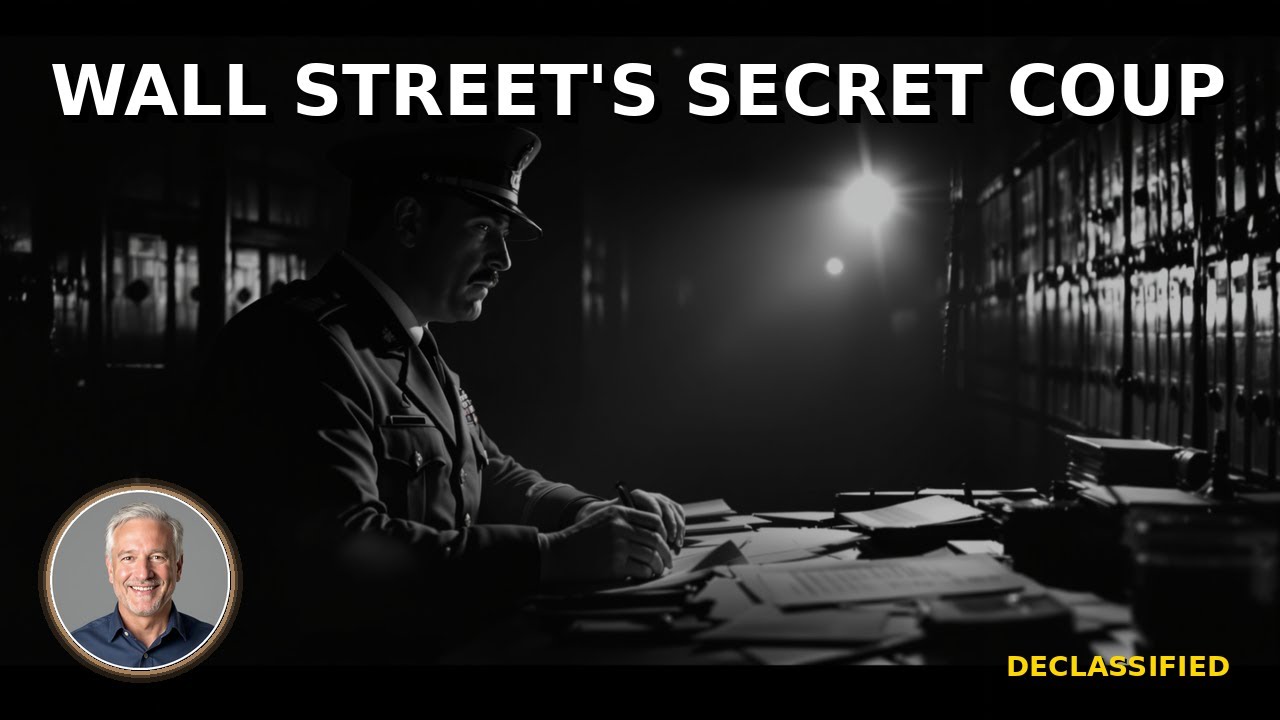
Grayson Mallet-Prevost Murphy represents one of the most enigmatic figures in American financial and political history—a man whose name appears at the intersection of Wall Street power and alleged conspiracies against democratic governance. Born in 1878 to a prominent New York family, Murphy embodied the interconnected worlds of high finance, military service, and political influence that defined America’s elite in the early 20th century.
Wall Street Power Broker
Murphy’s career trajectory reads like a blueprint for financial and political influence. After graduating from West Point in 1898, he served as a cavalry officer before transitioning to Wall Street, where he became a partner at the prestigious investment firm Guaranty Trust Company. By the 1920s, Murphy had established himself as one of New York’s most connected financial figures, serving on numerous corporate boards and maintaining extensive relationships throughout the business community.
His position at Guaranty Trust placed him at the center of American international finance during a critical period. The firm handled significant German investments and maintained complex relationships with European banks, positioning Murphy as a key figure in transatlantic financial networks. This role gave him intimate knowledge of how international capital flows could influence domestic politics—knowledge that would prove significant during the economic upheaval of the 1930s.
The Business Plot Allegations
Murphy’s historical significance stems largely from his alleged role in what became known as the Business Plot of 1933-34. According to testimony given to Congress by Marine Corps Major General Smedley Butler, Murphy served as a key intermediary in a conspiracy to recruit Butler to lead a fascist coup against President Franklin D. Roosevelt. Butler testified that Murphy, representing a coalition of wealthy businessmen, approached him with a plan to create a veterans’ organization that would pressure FDR to step aside in favor of a government more amenable to business interests.
The allegations placed Murphy at the center of what the House Un-American Activities Committee would later acknowledge as a genuine conspiracy. Butler’s testimony described Murphy as one of the principal organizers, using his extensive Wall Street connections to coordinate funding and support for the plot. The plan allegedly involved creating a 500,000-strong veterans’ army that would march on Washington, ostensibly to protect the president but actually to force his resignation.
What makes Murphy’s involvement particularly significant is how it illustrates the desperation of certain financial elites during the New Deal era. Roosevelt’s banking reforms, securities regulations, and social programs represented an existential threat to the unchecked power that figures like Murphy had wielded for decades. The alleged plot wasn’t merely about removing one president—it was about preserving a system of economic governance where Wall Street maintained primacy over democratic institutions.
Legacy and Historical Impact
Murphy’s story reveals the fragility of democratic institutions when faced with organized opposition from entrenched financial interests. While no arrests were made following the congressional investigation, the Business Plot allegations exposed the extent to which some American business leaders were willing to go to preserve their power. Murphy’s alleged role demonstrates how respectable establishment figures could contemplate overthrowing constitutional government when their economic interests were threatened.
The broader significance of Murphy’s story lies in what it reveals about the relationship between concentrated wealth and democratic governance. His career illustrates how financial networks can transcend traditional political boundaries, creating parallel power structures that operate independently of electoral accountability. Whether or not the specific allegations against Murphy were fully accurate, his story serves as a crucial reminder of the ongoing tension between democratic values and plutocratic power in American history.