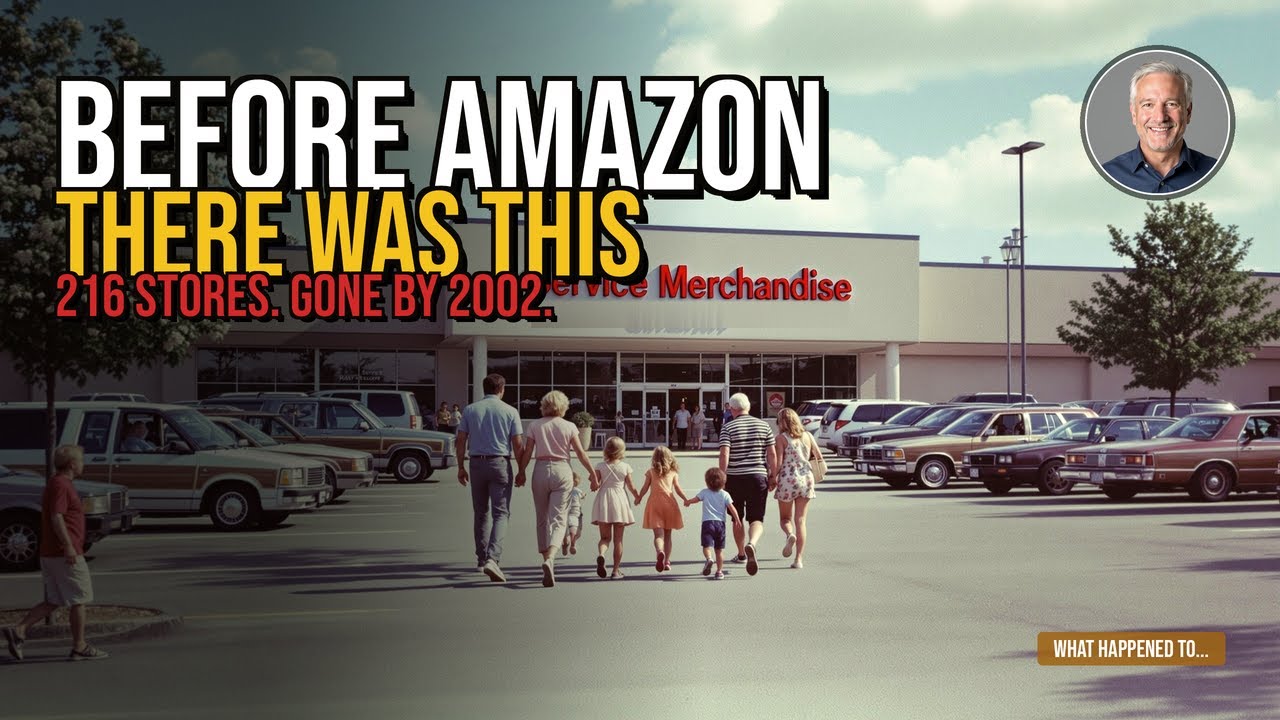
What Happened To...
What Happened to Service Merchandise?
Service Merchandise was the largest jewelry retailer in the United States before it closed
Founding Service Merchandise catalog showroom chain
Appears in 1 documentary
Harry Zimmerman transformed American retail through a simple but revolutionary idea: let customers see merchandise they couldn’t touch. As the founder and driving force behind Service Merchandise, he built what would become the nation’s largest jewelry retailer and pioneered the catalog showroom format that defined middle-class shopping for three decades.
In 1960, Zimmerman opened his first Service Merchandise store in Nashville, Tennessee, introducing Americans to an entirely new way of shopping. Unlike traditional department stores, his catalog showrooms displayed sample merchandise behind glass while customers ordered items from catalogs for pickup at a central warehouse counter. This hybrid approach combined the convenience of catalog shopping with the confidence of seeing products firsthand.
Zimmerman’s innovation wasn’t just about retail logistics—it was about democratizing access to quality goods. By reducing overhead costs through warehouse-style operations and bulk purchasing, Service Merchandise could offer brand-name jewelry, electronics, and household items at prices significantly below traditional retailers. The company’s slogan, “Name brands for less,” became a promise that resonated with middle-class families stretching their budgets.
The timing proved perfect. As suburban shopping centers proliferated in the 1960s and 1970s, Service Merchandise expanded rapidly across the South and Midwest. Zimmerman had identified a sweet spot in American retail: customers who wanted better merchandise than discount stores offered but couldn’t afford department store prices. By 1977, the company operated over 200 stores and generated more than $500 million in annual revenue.
Under Zimmerman’s leadership through the 1970s and early 1980s, Service Merchandise reached extraordinary heights. The company became a Fortune 500 corporation, operating nearly 400 stores across 35 states by the mid-1980s. Its jewelry counters alone generated more revenue than most standalone jewelry stores, making it America’s largest jewelry retailer by volume.
However, Zimmerman’s creation faced mounting challenges as retail landscapes shifted. The rise of big-box retailers like Walmart and electronics superstores offered similar products with immediately available inventory, eliminating the wait times inherent in Service Merchandise’s catalog system. When private equity firm Bain Capital acquired the company in 1999, the catalog showroom model that Zimmerman had pioneered was already becoming obsolete.
The final blow came as e-commerce emerged. Online shopping offered the same benefits Zimmerman had provided—vast selection, competitive prices, and home delivery—without requiring physical showrooms. Service Merchandise filed for bankruptcy in 2002, closing its remaining 300 stores and ending 42 years of operations.
Zimmerman’s influence extended far beyond Service Merchandise itself. The catalog showroom format he created spawned numerous imitators, including Best Products, Consumers Distributing, and Brendle’s, collectively generating billions in retail sales through the 1980s and 1990s. His approach to inventory management and customer service influenced modern retail concepts, from warehouse clubs to online retailers that combine showrooms with distribution centers.
More fundamentally, Zimmerman understood that American consumers wanted transparency in retail. His glass display cases and published catalog prices challenged the traditional department store model where pricing seemed arbitrary and negotiation was expected. This emphasis on clear, consistent pricing became standard across modern retail.
Today, as e-commerce giants grapple with the challenge of letting customers “see before they buy,” Zimmerman’s hybrid approach seems remarkably prescient. Apple Stores, Tesla showrooms, and other experience-focused retailers echo his insight that customers need both information and tactile confidence before making significant purchases. Though Service Merchandise itself didn’t survive the digital revolution, Harry Zimmerman’s understanding of consumer psychology continues to shape how Americans shop.
Explains how Walmart's pricing strategy ultimately destroyed Zimmerman's catalog showroom model and Service Merchandise.
Service Merchandise's decline after Zimmerman's era exemplifies Collins' five stages of corporate failure.
Service Merchandise was the largest jewelry retailer in the United States before it closed