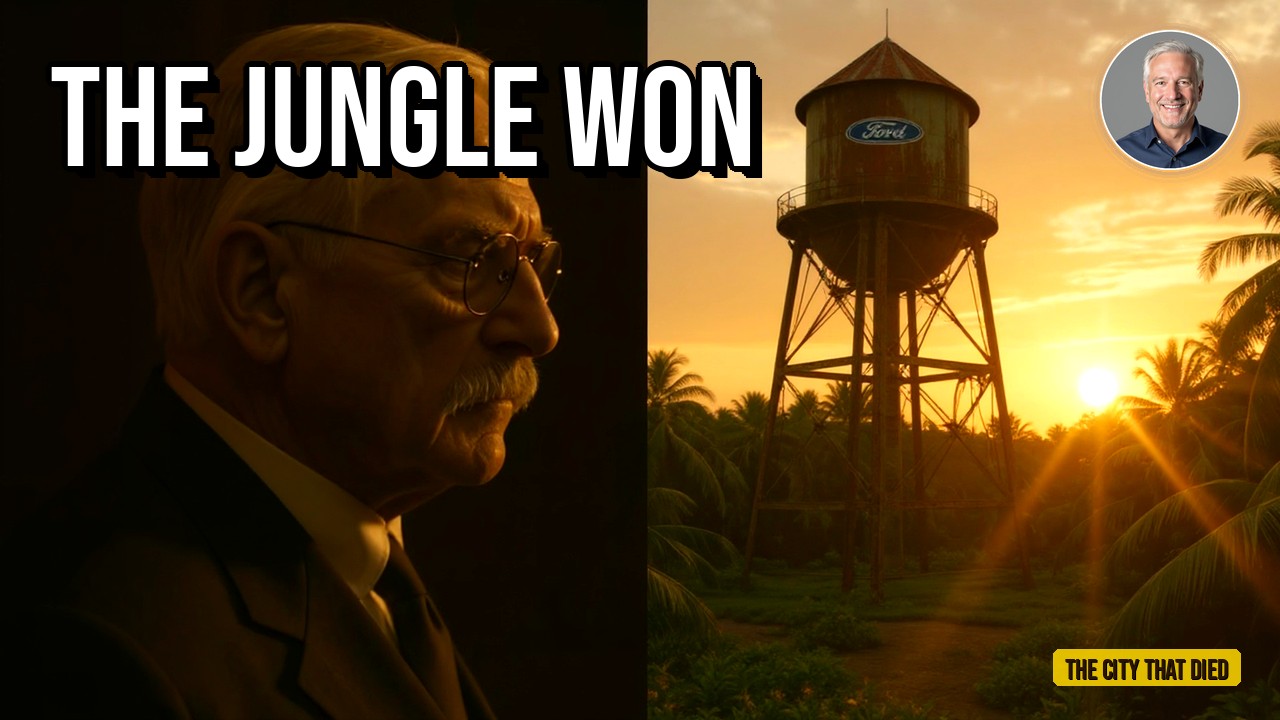
James Weir was the Scottish-born engineer who became the unlikely architect of one of industrial history’s most spectacular failures. As Henry Ford’s chief representative in the Brazilian Amazon, Weir found himself tasked with transforming 2.5 million acres of dense rainforest into a modern rubber plantation that would fuel Ford’s automotive empire. What resulted instead was a cautionary tale about the limits of American industrial ambition when confronted with the realities of tropical geography and cultural resistance.
The Engineer in the Jungle
Appointed to oversee Fordlandia in 1928, Weir arrived in Brazil with the confidence typical of American industrial managers of the era. Ford had purchased the vast tract of land along the Tapajós River for $125,000, believing that American efficiency and organization could succeed where Brazilian rubber cultivation had previously faltered. Weir’s mandate was clear: create a model American town in the heart of the Amazon that would produce enough rubber to make Ford Motor Company independent of British and Dutch rubber cartels.
Weir threw himself into the project with characteristic engineering precision. He supervised the construction of sawmills, power plants, hospitals, and schools, all designed according to American specifications. The town featured neat rows of company houses, complete with screened porches and manicured lawns—a surreal transplantation of Midwestern suburbia into one of the world’s most challenging environments. Under Weir’s direction, workers cleared thousands of acres and planted rubber trees in orderly rows, mimicking the agricultural methods that had proven successful in temperate climates.
The December Revolt
Weir’s rigid adherence to Ford’s cultural imperatives ultimately precipitated the crisis that would define his legacy. Following company policy, he enforced a strict regimen that banned alcohol, mandated American-style meals in company cafeterias, and required workers to participate in square dancing and poetry readings after their shifts. These policies reflected Ford’s paternalistic belief that American culture was inherently superior and could be successfully exported anywhere in the world.
The Brazilian workers’ patience finally snapped in December 1930. What began as grumbling over the cafeteria’s unfamiliar American cuisine—featuring dishes like oatmeal and whole wheat bread that were alien to local palates—escalated into a full-scale revolt. Workers smashed equipment, overturned company vehicles, and chased Weir and other American managers into the jungle with machetes. The scene was both farcical and terrifying: highly educated engineers fleeing through dense rainforest from laborers wielding farm tools, a vivid metaphor for the collision between industrial ambition and cultural reality.
Legacy of Failed Paternalism
Weir’s experience at Fordlandia illuminated the fundamental flaws in early 20th-century American corporate expansion. His story represents more than just poor management; it exemplifies the era’s profound misunderstanding of how culture, climate, and local knowledge intersect in ways that cannot be overcome through sheer industrial might. The rubber trees, planted in neat rows as Weir supervised, became vulnerable to leaf blight in ways that the naturally scattered wild rubber trees were not—a biological lesson that no amount of American engineering expertise could override.
The failure of Fordlandia under Weir’s management cost Ford Motor Company over $20 million and served as an early warning about the complexities of global industrialization. Weir’s meticulous records and reports, preserved in Ford’s archives, provide historians with a detailed account of how well-intentioned but culturally tone-deaf management could transform a promising venture into a disaster. His story continues to resonate in discussions about corporate responsibility, cultural sensitivity, and the environmental challenges of industrial development in tropical regions.