50 States Forgotten History
Ohio's River Caught Fire and Changed America
The Rankin family beacon in Ripley guided 2,000 enslaved people to freedom across the Ohio River
Standard Oil founder and America's first billionaire
1839-1937
Appears in 1 documentary
Cleveland, Ohio, 1870. John D. Rockefeller incorporated Standard Oil, planting the seed of an industrial empire that would come to define — and ultimately disfigure — Ohio’s rivers, air, and soil. By 1879, Standard Oil controlled roughly 90 percent of U.S. oil refining capacity. The company’s refineries, pipelines, and chemical byproducts didn’t stay contained to ledger books. They poured into the Cuyahoga River, a waterway that would become, a century later, the most infamous symbol of American industrial recklessness.
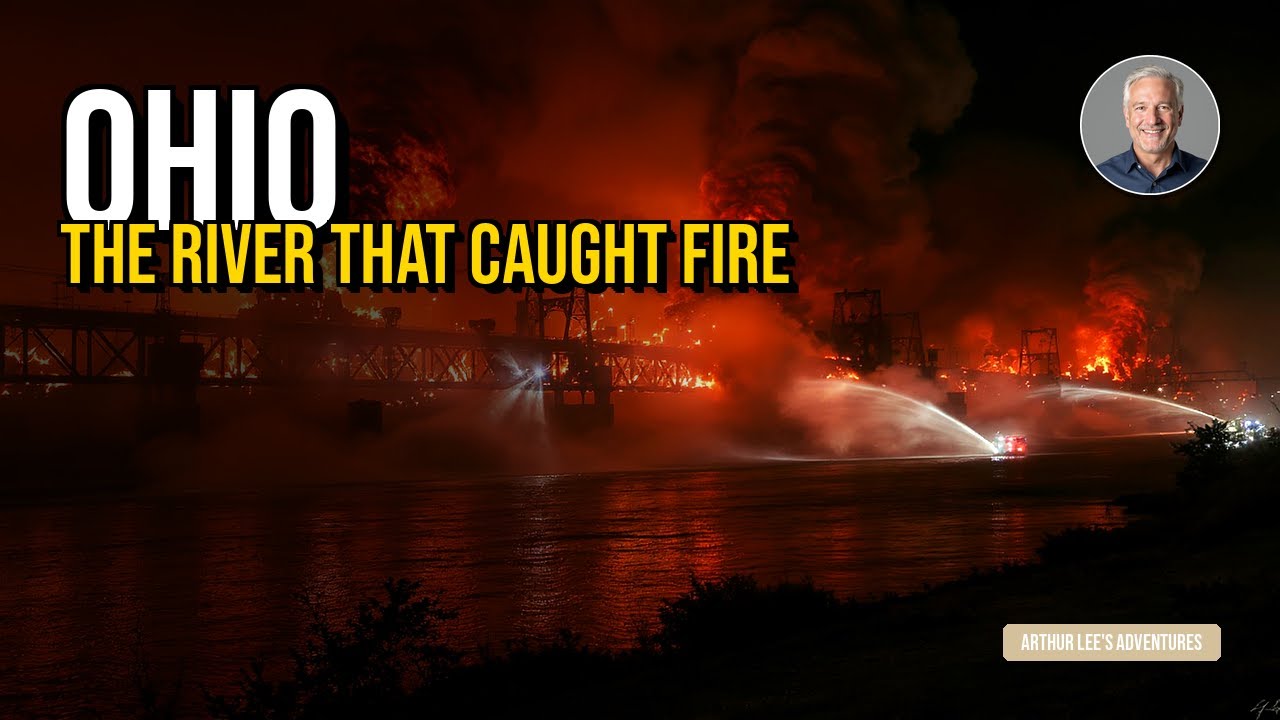
Arthur Lee’s “Think You Know Ohio?” episode is not primarily about Rockefeller — but it cannot tell Ohio’s full story without him. Standard Oil’s Cleveland headquarters made the city one of the wealthiest industrial centers in the world during the late 19th century. The refineries that powered that wealth discharged oil slicks, chemical waste, and industrial runoff into the Cuyahoga for decades. The river caught fire multiple times throughout the 20th century, but it was the June 22, 1969 blaze — burning for roughly 30 minutes and causing an estimated $50,000 in damage to two railroad bridges — that finally broke through the public consciousness. Time magazine ran a photo. The nation recoiled. The Environmental Protection Agency was established in December 1970, and the Clean Water Act followed in 1972.
Rockefeller was long dead by then. But Standard Oil’s industrial logic — extract, refine, discharge, repeat — had shaped the culture and infrastructure of the Cuyahoga Valley for generations. The fire was not an accident of one bad actor. It was the accumulated consequence of an entire industrial era that Rockefeller, more than almost anyone, had built.
Most Rockefeller profiles focus on philanthropy, monopoly, or the drama of the Standard Oil breakup in 1911. What rarely gets examined is the geographic and environmental footprint his empire left in Ohio specifically — the state where the fortune was made. The Cuyahoga did not become a flaming river because of one company or one decision. It became a flaming river because Ohio’s industrial identity, shaped heavily by Standard Oil’s early dominance, normalized the river as a dump.
Arthur Lee’s episode places Rockefeller’s Ohio legacy inside a longer, stranger arc of state history — one that also includes the Wright Brothers testing flight in Dayton, the Cincinnati Red Stockings becoming America’s first professional baseball team in 1869, and the Rankin family in Ripley guiding over 2,000 enslaved people across the Ohio River to freedom. These are not disconnected facts. They are portraits of a state that simultaneously produced extraordinary human courage and extraordinary industrial damage, often in the same generation.
The documentary frame matters here. Lee is not making a case against Rockefeller or for him. He’s using the Cuyahoga fire as the pivot point that most Ohioans recognize — a moment of national shame that produced landmark environmental law — and tracing it back to the industrial conditions that made such a fire not just possible but almost inevitable.
A brief note for context: Standard Oil of Ohio was Rockefeller’s original company, founded in Cleveland when he was 30 years old. Its consolidation of regional refineries gave it unmatched logistical and economic power, and it transformed northeastern Ohio into one of the world’s great industrial corridors.
What Lee reveals is that Ohio’s complexity cannot be reduced to any single story. The same state that sheltered freedom seekers on the Underground Railroad also built the industrial infrastructure that choked its own waterways. Rockefeller sits inside that contradiction — not as a villain, not as a hero, but as the man whose ambition shaped what Ohio would cost itself.
The definitive account of Rockefeller's rise through Cleveland and Standard Oil — essential for understanding how his industrial machine reshaped Ohio's environment and economy.
Places Rockefeller's Standard Oil era within Ohio's full industrial arc, from frontier territory to the environmental reckoning of the 1960s.
A portrait of the Ohio ingenuity that flourished alongside Rockefeller's industrial age — two very different faces of the same state in the same era.
The Rankin family beacon in Ripley guided 2,000 enslaved people to freedom across the Ohio River