50 States Forgotten History
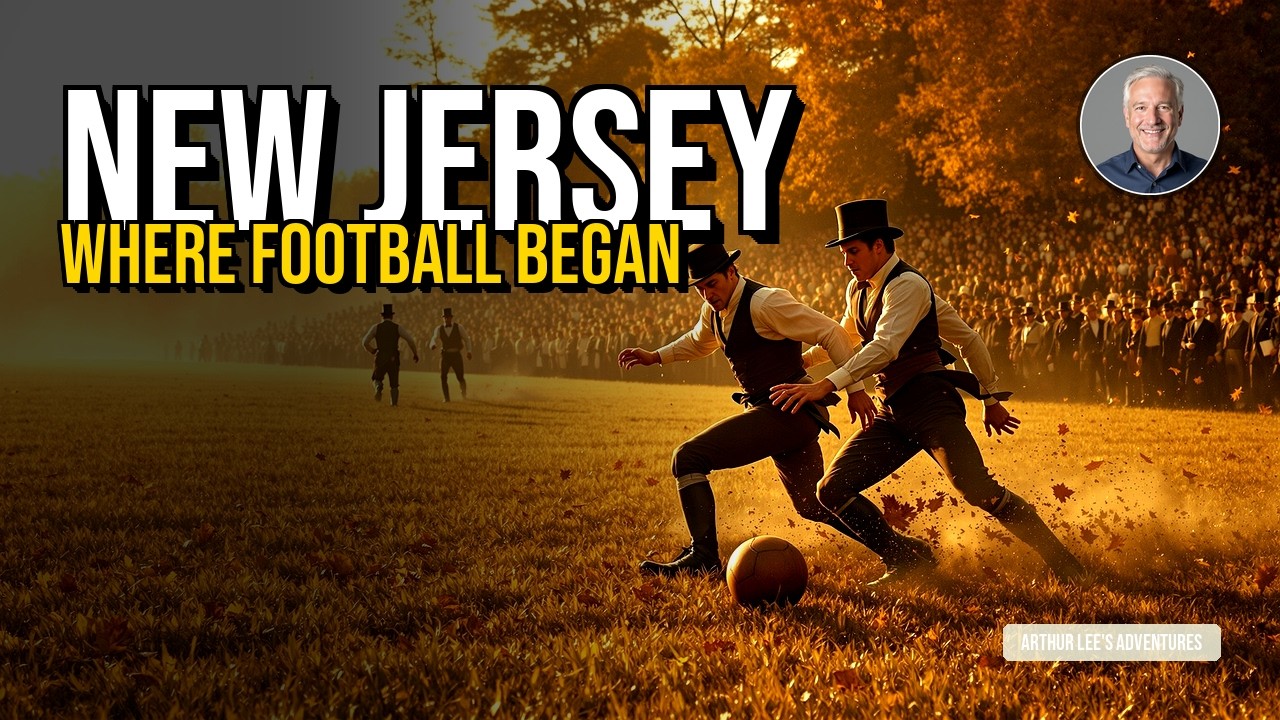
New Jersey Discovered Football. Well, sort of.
The first intercollegiate football game was played in New Brunswick, NJ in 1869 — 25 years before the sport had formal rules
Father of American vertebrate paleontology
Appears in 2 documentaries
Philadelphia in the mid-nineteenth century was one of the great scientific capitals of the world, and no figure embodied that moment more completely than Joseph Leidy. A physician by training, a naturalist by obsession, and a teacher by vocation, Leidy transformed American science during a period when the continent itself seemed to be giving up its secrets — bone by bone, stratum by stratum, from the marl pits of New Jersey to the badlands of the Dakota Territory.
Born in Philadelphia on September 9, 1823, Leidy showed an early and insatiable curiosity about the natural world. He earned his medical degree from the University of Pennsylvania in 1844, and while he practiced medicine competently throughout his life, it was never his true calling. What consumed him was everything else: fossils, parasites, microscopic organisms, extinct mammals, and the deep question of what life on Earth had looked like before human memory began.
In 1858, Leidy achieved what many consider his signal contribution to science. Working with bones excavated from a marl pit in Haddonfield, New Jersey — specimens collected by amateur fossil hunter William Parker Foulke — Leidy described and named Hadrosaurus foulkii, the first nearly complete dinosaur skeleton ever mounted and displayed in the world. The reconstruction, unveiled at the Academy of Natural Sciences in Philadelphia, was revolutionary. Leidy recognized that the animal’s hind limbs were significantly longer than its forelimbs, suggesting it stood partially upright — a posture that overturned the prevailing image of dinosaurs as sluggish, lizard-like creatures. It was a deduction that would influence paleontology for generations, and it came not from a well-funded expedition but from a New Jersey farm field and Leidy’s meticulous eye.
What makes Leidy unusual — and in some ways underappreciated — is that dinosaurs were only one corner of his enormous intellectual territory. He was a pioneering parasitologist, identifying Trichinella spiralis in pork muscle in 1846, a discovery with direct public health implications. He contributed foundational work in protozoology, describing hundreds of microscopic organisms with the same careful hand he brought to fossil vertebrates. His 1869 monograph The Extinct Mammalian Fauna of Dakota and Nebraska remains a landmark document in the history of American natural history.
He also taught for decades at the University of Pennsylvania, shaping generations of American scientists during a period when the profession itself was being invented. Leidy worked in an era before federal science agencies dominated the field, when a single curious man with a microscope and a fossil cabinet could still move the entire boundary of human knowledge.
His character was as notable as his output. In an age of fierce scientific rivalry — the so-called Bone Wars between Othniel Charles Marsh and Edward Drinker Cope would consume the last decades of the century — Leidy largely withdrew from vertebrate paleontology rather than compete in the increasingly bitter and well-funded scramble for Western fossils. He found the atmosphere distasteful and redirected his energy toward microscopy and parasitology. It was a graceful retreat from one arena and a complete mastery of another.
Joseph Leidy died on April 30, 1891, in Philadelphia, the city where he had spent virtually his entire life. He left behind more than 800 scientific publications and a transformed understanding of prehistoric life in North America. The mounted Hadrosaurus skeleton that he described helped shift public imagination about deep time and the creatures that once ruled the Earth — arriving just three years after Darwin’s On the Origin of Species and lending sudden, dramatic, skeletal weight to the idea of evolution.
His legacy is embedded in the institutional life of Philadelphia — in the Academy of Natural Sciences, which he served for decades, and in the University of Pennsylvania, where his name endures in the Leidy Laboratories of Biology. More broadly, he is the reason American paleontology had a foundation to build on. Every subsequent discovery of North American prehistoric life — every Tyrannosaurus, every Triceratops, every fossil that fills a museum hall — stands, in some measure, on the methodical, generous, and brilliant work of the Philadelphia doctor who first taught Americans to read the bones beneath their feet.
Brusatte's authoritative account of dinosaur science gives essential context for why Leidy's 1858 Hadrosaurus description was such a turning point in how humans understood prehistoric life.
Free with Audible trial. The audiobook version of Brusatte's landmark work — the best modern account of the science Leidy helped found.
The first intercollegiate football game was played in New Brunswick, NJ in 1869 — 25 years before the sport had formal rules

On May 27, 1962, the Centralia volunteer fire department set a trash fire that ignited an exposed coal seam. The fire spread through underground mines beneath the town. Over sixty years later, it still burns today. The federal government spent over $42 million relocating residents. By 2010, only ten remained of the original fourteen hundred.