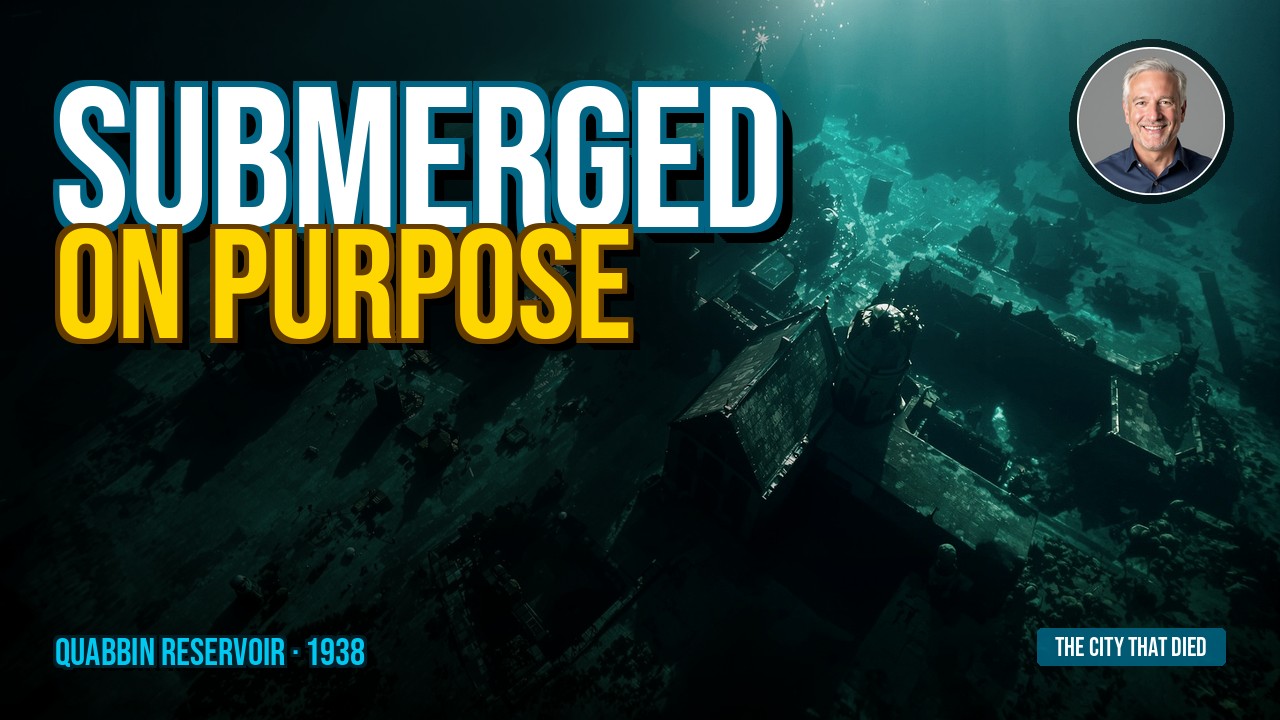
The City That Died
The Day Four Towns Drowned So Boston Could Drink
On April 27, 1938, the town of Enfield held a farewell ball — at midnight, as the town legally ceased to exist, residents danced until dawn
Massive water infrastructure projects enabling Southern California's growth
Appears in 1 documentary
The Metropolitan Water District stands as one of the most powerful and consequential public agencies in American history, fundamentally reshaping not just Southern California’s landscape, but the entire trajectory of the American West. Founded in 1928, this sprawling water authority became the institutional force behind one of the largest human migrations in world history, enabling millions to settle in what had been an arid, sparsely populated region.
The Metropolitan Water District emerged from a simple yet audacious premise: that geography need not determine destiny. In the 1920s, Southern California faced a stark reality. Its population was exploding, but its water resources remained painfully limited. Local leaders recognized that without a massive infusion of water from distant sources, the region’s growth would inevitably stall. The solution they devised was breathtaking in its scope and ambition.
The District’s first and most famous achievement was the Colorado River Aqueduct, completed in 1941. This 242-mile engineering marvel transported water across deserts and mountains, requiring the construction of five pumping plants that lifted water over 1,600 feet uphill. The project employed 35,000 workers during the Great Depression and cost $220 million—roughly $4 billion in today’s dollars. More than infrastructure, it represented a fundamental reimagining of how Americans could reshape their environment through collective action and technological prowess.
The Metropolitan Water District’s influence extended far beyond engineering. It pioneered new forms of regional governance, creating a model that other water-scarce regions would later adopt. Its member agencies spanned multiple counties, demonstrating how local governments could band together to tackle challenges that transcended traditional political boundaries. This institutional innovation proved as important as any pipeline or reservoir.
Yet the District’s story is not merely one of triumph over nature. Its projects often came at enormous human cost, particularly to rural and marginalized communities whose lands were claimed for reservoirs, aqueducts, and rights-of-way. Small towns disappeared beneath rising waters, their residents forced to relocate as larger urban centers demanded their resources. These communities rarely had the political power to resist, illustrating how water policy often reflected broader patterns of inequality and displacement in 20th-century America.
The District’s expansion also sparked fierce legal and political battles over water rights that continue today. Its aggressive acquisition of Colorado River water put it in conflict with other states and Native American tribes, creating tensions that reverberate through contemporary Western politics. The agency’s early leaders understood that water was not merely a commodity but a form of political power, and they wielded it accordingly.
Today, the Metropolitan Water District serves nearly 19 million people across six counties, making it the largest water utility in the United States. Its infrastructure moves billions of gallons daily from sources as distant as the Colorado River and Northern California, enabling the existence of the nation’s second-largest metropolitan area in a region that receives less than 15 inches of annual rainfall.
The District’s true historical significance lies not in its impressive statistics, but in its demonstration of how public institutions could fundamentally alter the trajectory of American development. It proved that through collective action, technological innovation, and massive capital investment, entire regions could transcend their natural limitations. This vision of engineered abundance became central to the American West’s identity and continues to shape debates over sustainability, growth, and resource management across the nation.
Marc Reisner's classic chronicles the Metropolitan Water District's role in the epic transformation of the American West through massive water projects.
Donald Worster's influential work examines how institutions like the Metropolitan Water District created hydraulic societies that reshaped Western civilization.
The definitive institutional history of the MWD, chronicling its evolution from regional water authority to major political force.
On April 27, 1938, the town of Enfield held a farewell ball — at midnight, as the town legally ceased to exist, residents danced until dawn