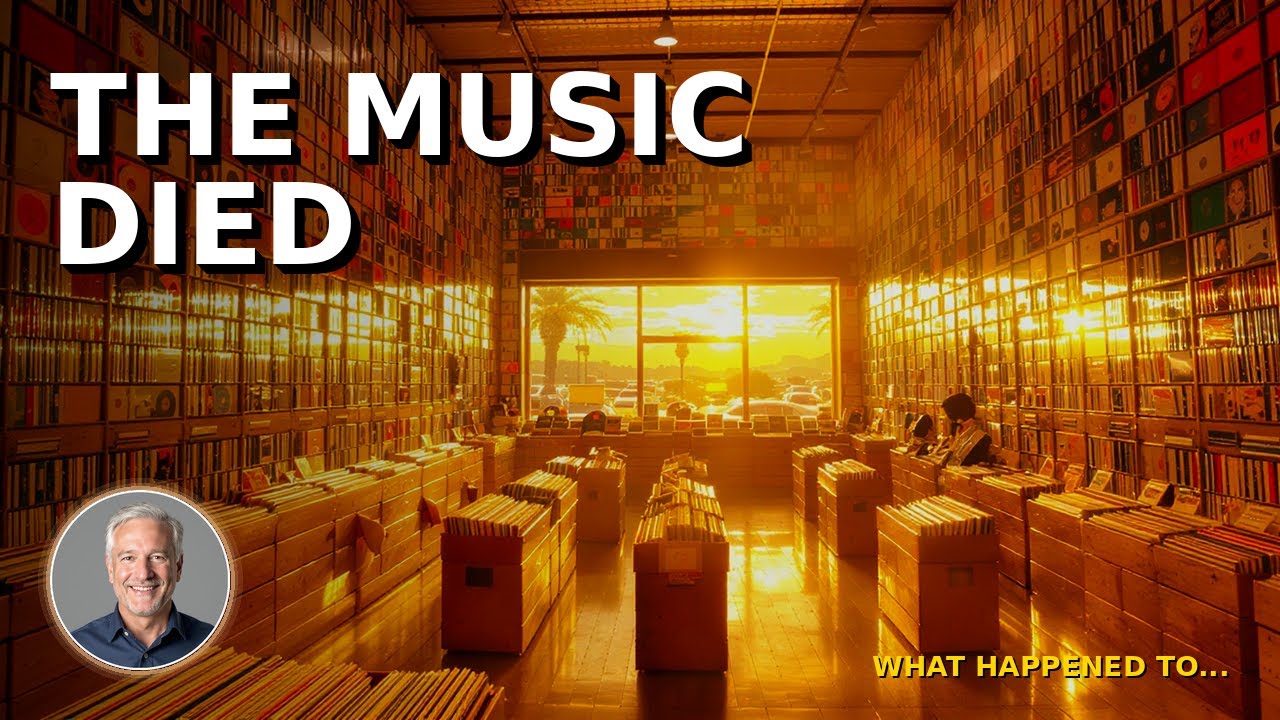
What Happened To...
What Happened to Tower Records?
Tower Records had 214 stores in 15 countries and one billion dollars in revenue before Napster killed it
Founder of Tower Records
1925-2018
Appears in 1 documentary
Russ Solomon transformed the way Americans discovered and consumed music, building Tower Records from a small Sacramento drugstore into the world’s most influential music retailer. His empire would eventually span the globe with 214 stores across 15 countries, generating over one billion dollars in annual revenue before digital piracy and changing consumer habits brought it crashing down in 2006.
Born Russell Solomon in 1925, the future retail revolutionary stumbled into the music business almost by accident. In 1941, at just 16 years old, Solomon began working at his father’s Tower Cut Rate Drugs in Sacramento, California. What started as a teenager selling used jukebox records from a corner of the pharmacy would evolve into a retail phenomenon that defined music culture for generations.
Solomon’s genius lay not in understanding music—he often admitted his tastes were unremarkable—but in understanding music lovers. He recognized that serious record buyers wanted selection, depth, and discovery. While other retailers treated records as just another product, Solomon treated them as cultural artifacts deserving of cathedral-like spaces where customers could browse for hours. Tower Records stores became temples to musical obsession, with their trademark yellow and red signage becoming synonymous with musical pilgrimage.
By the 1960s, Solomon had transformed Tower into something unprecedented: a store that carried everything, organized by genre, staffed by music fanatics who could discuss the obscure B-sides of forgotten bands. The flagship Sunset Strip location, opened in 1971, became legendary—a place where rock stars shopped alongside teenage fans, where you could find rare imports, bootlegs, and the deepest catalog of any artist imaginable.
Solomon’s expansion philosophy was audaciously simple: find music-obsessed managers, give them enormous freedom, and let local taste drive inventory decisions. This decentralized approach allowed Tower to maintain its countercultural credibility even as it grew into a corporate giant. By the 1990s, Tower had conquered international markets, with iconic locations in Tokyo, London, and Dublin becoming cultural landmarks in their own right.
The company’s success stemmed from Solomon’s fundamental insight that music retail was experiential, not transactional. Tower stores were designed for discovery—listening stations, knowledgeable staff, and inventory so deep that customers never knew what treasures they might uncover. This philosophy generated fierce customer loyalty and made Tower the preferred destination for serious music collectors worldwide.
Solomon’s empire faced its greatest challenge not from competing retailers, but from technology itself. The rise of Napster and digital piracy in the late 1990s fundamentally altered music consumption patterns. Customers who once bought entire albums based on a single song could now download just the tracks they wanted—or pirate them entirely. CD sales, Tower’s primary revenue source, began a precipitous decline that would prove irreversible.
Despite recognizing the threat, Solomon and Tower proved unable to adapt quickly enough to the digital revolution. The company’s strength—vast physical spaces filled with deep inventory—became a crushing liability when customers shifted to online purchasing and digital downloads. Burdened by massive lease obligations and declining sales, Tower Records filed for bankruptcy in 2004 and liquidated completely by 2006.
Solomon’s story embodies the classic innovator’s dilemma: the very strategies that made Tower dominant in the physical era rendered it vulnerable to digital disruption. His death in 2018 marked the end of an era when music discovery required physical pilgrimage to stores like Tower, where passionate curation and serendipitous browsing shaped musical taste. Solomon didn’t just sell records—he created a culture of musical exploration that influenced how multiple generations discovered and connected with music.
The definitive account of how MP3 piracy destroyed the music industry that made Solomon's Tower Records empire possible.
Explains why successful companies like Solomon's Tower Records fail when disruptive technologies emerge.
Documentary chronicling Russ Solomon's journey from Sacramento drugstore to global music empire and ultimate collapse.
Tower Records had 214 stores in 15 countries and one billion dollars in revenue before Napster killed it