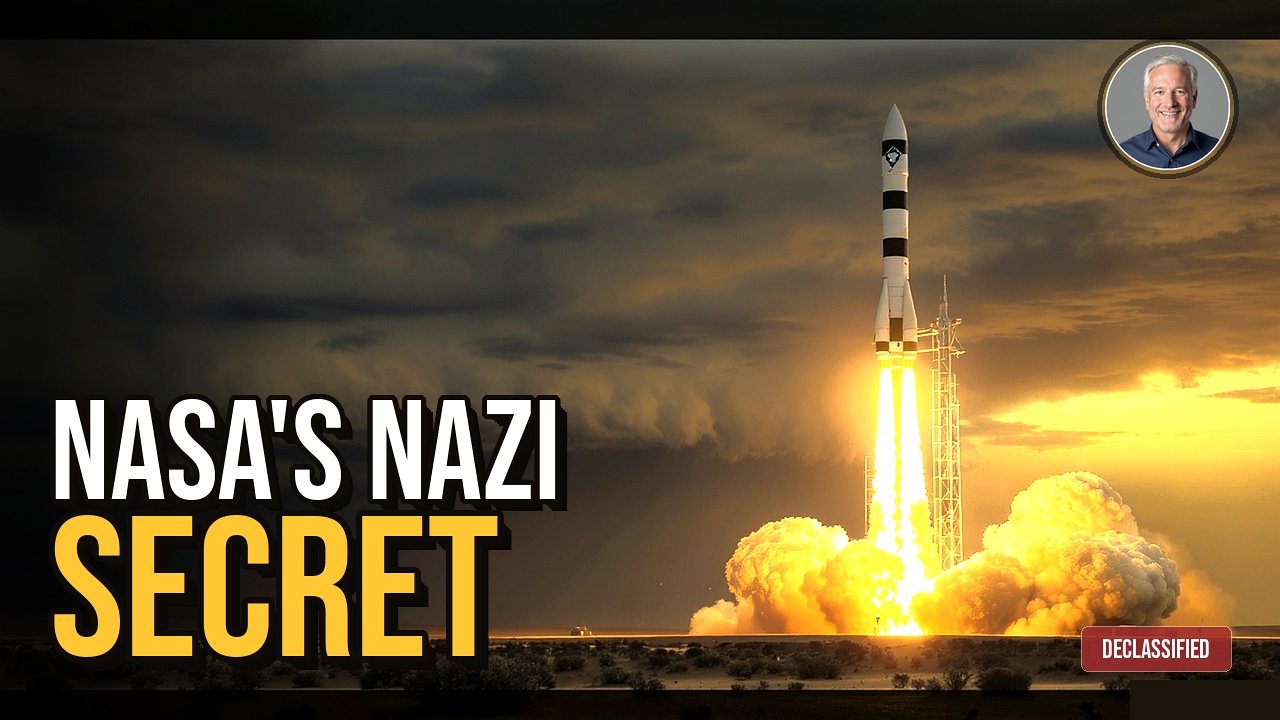
Wernher von Braun embodied one of the most morally complex legacies in modern history: a brilliant engineer whose rockets both terrorized London and carried Americans to the moon. His story illuminates how the United States, in its rush to win the Cold War, embraced former Nazi scientists while quietly erasing their wartime crimes.
From Nazi Rocket Engineer to American Hero
Born in 1912 to Prussian nobility, von Braun discovered his passion for rocketry as a teenager, joining amateur rocket societies in 1930s Germany. His talents quickly caught the attention of the German military, and by 1937, he was developing ballistic missiles for the Wehrmacht at the secret Peenemünde facility on the Baltic coast.
During World War II, von Braun rose to become technical director of Germany’s V-2 rocket program while holding the rank of Sturmbannführer (major) in Heinrich Himmler’s SS. The V-2, the world’s first operational ballistic missile, represented a quantum leap in military technology. Between September 1944 and March 1945, over 3,000 V-2s struck London, Antwerp, and other Allied targets, killing approximately 9,000 civilians and military personnel.
The human cost of von Braun’s rockets extended far beyond their targets. At the Mittelbau-Dora concentration camp in central Germany, an estimated 20,000 prisoners—including Jews, political prisoners, and foreign workers—died producing V-2 rockets under horrific conditions. Survivors described 12-hour shifts in underground tunnels, brutal beatings, starvation rations, and summary executions. Von Braun visited the facility multiple times and was intimately familiar with the conditions, yet continued to push for increased production.
Operation Paperclip and American Recruitment
As Nazi Germany collapsed in 1945, von Braun made a calculated decision that would define the rest of his life. Rather than surrender to the advancing Soviets, he led his team westward to surrender to American forces. This decision proved prescient: the United States was already implementing Operation Paperclip, a classified program to recruit German scientists before they could fall into Soviet hands.
American intelligence officers, recognizing von Braun’s value in the emerging Cold War, systematically whitewashed his Nazi past. His SS membership was downplayed, his knowledge of slave labor conditions was minimized, and his war crimes were buried in classified files. By 1950, von Braun was working at the Redstone Arsenal in Alabama, developing missiles for the U.S. Army while becoming a naturalized American citizen.
The transformation was remarkable in its thoroughness. Von Braun became a media darling, appearing on television shows, writing popular articles about space travel, and consulting with Walt Disney on educational films about rocket technology. His boyish enthusiasm and thick German accent made him an unlikely but effective spokesman for America’s space ambitions.
Legacy of Moral Compromise
Von Braun’s most visible triumph came on July 20, 1969, when his Saturn V rocket successfully delivered Apollo 11 to the moon. As Neil Armstrong and Buzz Aldrin walked on the lunar surface, von Braun stood vindicated as the father of American space exploration. The moment represented the ultimate rehabilitation of a former Nazi officer into an American hero.
Yet this transformation came at a profound moral cost. By recruiting von Braun and hundreds of other Nazi scientists, the United States sent a clear message that technical expertise could absolve even the gravest wartime crimes. The decision established a precedent of moral flexibility that would characterize much of America’s Cold War strategy.
Von Braun died in 1977, largely celebrated as a visionary who made human space exploration possible. His legacy remains deeply contested: a reminder that scientific progress and moral compromise often intertwine in ways that challenge simple narratives of good and evil. His story forces uncomfortable questions about whether the ends—American victory in the space race—justified the means of embracing former Nazi war criminals.