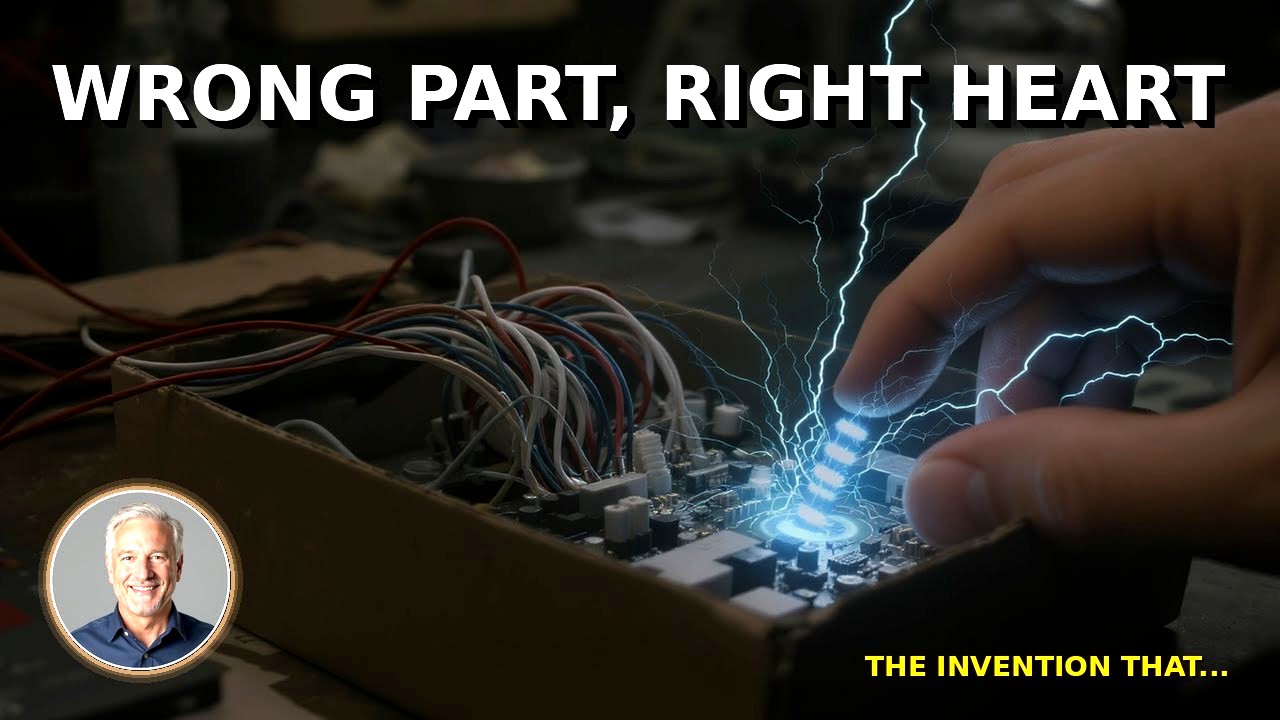
Wilson Greatbatch never intended to revolutionize medicine. On a cold day in 1958, the electrical engineer was hunched over his workbench in Buffalo, New York, building a device to record heart rhythms. He reached into his parts bin and grabbed what he thought was a 10,000-ohm resistor. Instead, he picked up a 1-megohm resistor—a mistake that would save millions of lives.
When Greatbatch powered up his circuit, instead of the steady recording device he expected, the machine began pulsing once per second. The rhythm was unmistakable: it mimicked a human heartbeat. In that moment of accidental discovery, Greatbatch realized he had stumbled upon something extraordinary—the foundation for an implantable cardiac pacemaker.
The Garage Workshop Revolution
Within three weeks of his mistake, Greatbatch had built the first working prototype of an implantable pacemaker in his garage workshop. This wasn’t just tinkering—it was precision engineering under primitive conditions. He sealed the device in epoxy resin and powered it with mercury batteries, creating a unit small enough to implant in the human chest. The device weighed just two ounces, a remarkable feat of miniaturization for 1958.
Born in 1919 in Buffalo, Greatbatch had spent his early career working on radio equipment and sonar systems during World War II. His background in electronics, combined with his interest in medical applications, positioned him perfectly for this breakthrough. But the pacemaker’s success required more than technical skill—it demanded the courage to pursue an idea that the medical establishment initially viewed with skepticism.
The first human implantation came in 1960, performed by Dr. William Chardack at Buffalo’s Veterans Administration Hospital. The patient lived for 18 months with the device—long enough to prove the concept worked. By 1961, Greatbatch had founded Medtronic’s pacemaker division, transforming a small medical device company into a global giant.
Beyond the Pacemaker
Greatbatch’s accidental discovery represents a crucial pattern in innovation history: the prepared mind meeting unexpected opportunity. Like Alexander Fleming’s discovery of penicillin or the invention of Post-it Notes, the pacemaker emerged from a mistake that only someone with deep expertise could recognize as revolutionary.
The timing was crucial. By 1958, transistors had made electronics small enough for implantation, while advances in battery technology provided reliable power sources. Surgical techniques had also evolved to make implantation feasible. Greatbatch’s “mistake” occurred at the precise intersection of these technological advances.
His innovation also highlighted a shift in medical treatment philosophy. Before the pacemaker, heart rhythm disorders were largely untreatable death sentences. The device introduced the concept of electronic medicine—using technology not just to diagnose problems but to actively replace failing biological functions. This principle would later inspire artificial hearts, cochlear implants, and deep brain stimulators.
Greatbatch continued inventing throughout his career, eventually holding over 325 patents. He developed improved battery technologies, worked on space satellite power systems, and created AIDS treatment devices. Yet none of his later inventions matched the pacemaker’s impact.
The Lifesaving Legacy
Today, over three million people worldwide live with pacemakers, with 700,000 new devices implanted annually. The modern pacemaker bears little resemblance to Greatbatch’s original garage-built prototype—contemporary devices are programmable computers that can adjust to a patient’s activity level and transmit data wirelessly to doctors. Yet they all trace their lineage to that wrong resistor in 1958.
Greatbatch’s story demonstrates how individual accidents can reshape entire fields when they occur in prepared minds. His willingness to recognize the significance of an unexpected pulse transformed a recording device malfunction into one of medicine’s most important innovations. In an age when medical breakthroughs often require massive research teams and billion-dollar budgets, the pacemaker’s origin in a Buffalo garage reminds us that revolutionary discoveries can still emerge from the most humble circumstances.