The Halifax Explosion of 1917: How Systemic Failure and One Man’s Courage Defined the Deadliest Day in Canadian History
On the morning of December 6, 1917, a French cargo ship called the Mont-Blanc sat low in Halifax Harbour, her hold packed with 2,900 tons of high explosives. She was, in the most literal sense, a floating bomb — loaded with picric acid, TNT, gun cotton, and benzol — making her way through the Narrows, the pinch point where Bedford Basin funnels into the harbour proper.
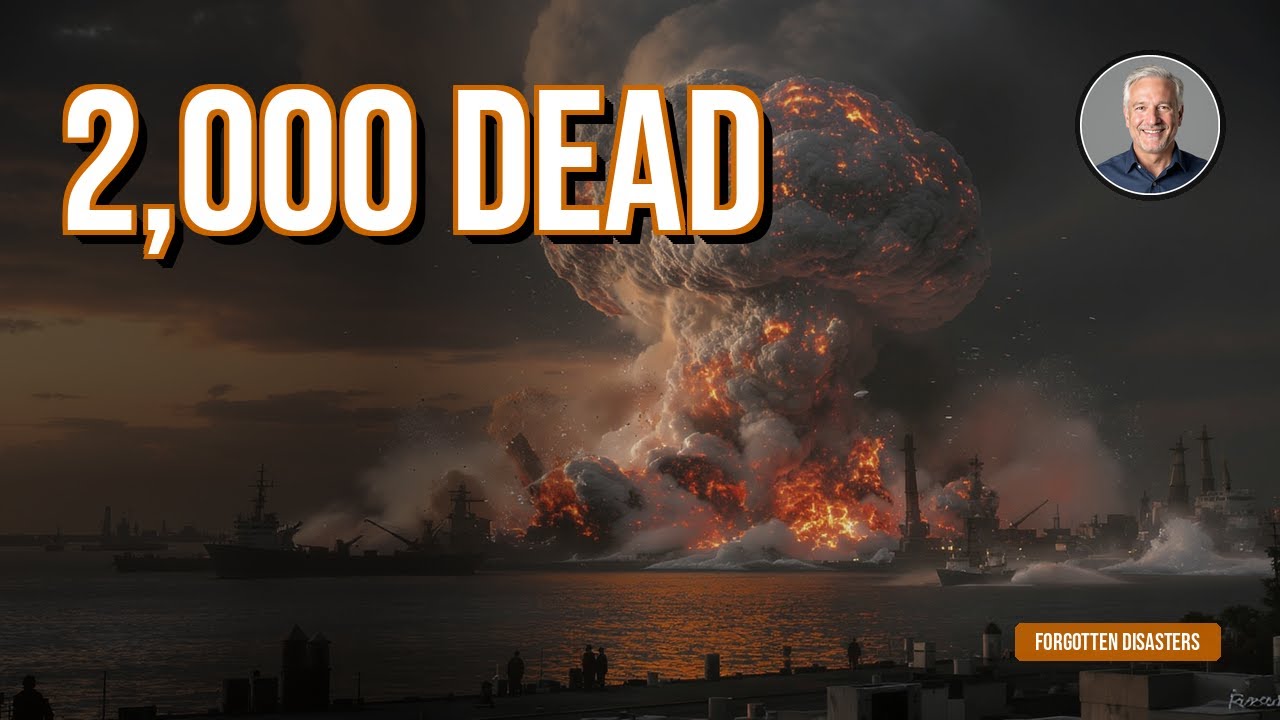
At 8:45 a.m., she collided with the Norwegian relief vessel Imo. The resulting fire burned for nearly twenty minutes while thousands of Halifax residents crowded their windows and rooftops to watch. At 9:04 a.m., the Mont-Blanc detonated.
The explosion remains the largest man-made blast in history before the atomic bomb. It killed approximately 1,800 people instantly — some estimates reach nearly 2,000 — injured 9,000 more, and flattened the northern half of Halifax and the neighboring community of Dartmouth. The pressure wave shattered windows 60 miles away. The sound was heard in Cape Breton, more than 200 miles distant. A column of smoke rose nearly 20,000 feet into the sky.
And then, the next morning, a blizzard buried the ruins under 16 inches of snow.
What followed was not just a rescue operation, but a reckoning — with wartime negligence, maritime bureaucracy, and the question of what human beings owe each other when systems fail completely.
A Harbour Built for Peace, Strained to Breaking by War
To understand how the Halifax Explosion happened, you have to understand what Halifax Harbour had become by 1917.
Before the First World War, Halifax was a moderately busy Atlantic port. By late 1917, it had transformed into one of the most critical shipping arteries in the Allied war effort. Convoys assembled in Bedford Basin before crossing the Atlantic. Relief ships arrived carrying food and supplies for war-ravaged Europe. Munitions vessels moved through constantly, their manifests often incompletely declared, their routes only loosely regulated.
The harbour was, in short, dangerously overcrowded and operating without anything resembling modern traffic control. Commander Frederick Wyatt served as the Chief Examining Officer responsible for regulating the movement of vessels through the Narrows — a role that proved catastrophically inadequate for the volume and volatility of wartime traffic. Ships communicated, but coordination was patchwork. Hazardous cargo declarations were inconsistent. And vessels carrying enough explosives to level a city moved through confined waters with limited oversight.
The Mont-Blanc had arrived the previous evening, December 5th, too late to enter the harbour. She anchored overnight and was cleared to proceed the following morning. Her captain, Aimé Le Medec, and her pilot, Francis Mackey, were navigating her through the Narrows when they encountered the Imo — a Norwegian vessel that had been delayed leaving Bedford Basin and was now moving faster than safe harbour speeds, on the wrong side of the channel.
The collision itself was almost slow-motion in retrospect. Both ships attempted course corrections. Both corrections were wrong. The Imo struck the Mont-Blanc on her starboard bow, rupturing barrels of benzol stored on deck. The friction ignited the fuel. The Mont-Blanc began to burn.
The Terrible Twenty Minutes
What happened next contains one of history’s most agonizing ironies. The crew of the Mont-Blanc knew exactly what their ship was carrying. They abandoned her immediately and rowed hard for the Dartmouth shore, shouting warnings in French that no one nearby understood.
The burning ship drifted toward Pier 6 in the Richmond district of Halifax — a densely populated working-class neighborhood. Halifax residents, unaware of her cargo, were fascinated. Children pressed their faces to school windows. Dockworkers paused their morning routines. Families climbed onto rooftops for a better view.
For nineteen minutes, the Mont-Blanc burned.
The blast radius was approximately one mile of near-total destruction. Beyond that, the pressure wave — traveling at roughly 3,000 feet per second — collapsed structures, shattered glass, and knocked people from their feet across the city. The Narrows itself briefly receded as the explosion displaced the water, sending a tsunami-like wave toward the shores of both Halifax and Dartmouth.
The Richmond district was essentially erased. Schools, factories, homes, and churches became rubble in the same six seconds. Many of the people who had been watching from windows were killed or permanently blinded by exploding glass — a detail that would later drive changes in how emergency responders treated blast injuries.
Vince Coleman and the Decision That Saved 300 Lives
In the history of the Halifax Explosion, no story has endured quite like that of Vince Coleman.
Coleman was a 46-year-old railway telegraph operator working at the Richmond rail yards, a few hundred yards from Pier 6. When word reached him that the burning ship carried explosives, he began to evacuate with his colleague Vincent Barron.
He got far enough to save himself. And then he turned around.
An express passenger train from Saint John was already approaching Halifax, carrying hundreds of civilians. Without a warning, it would arrive at the Richmond station within minutes of what Coleman now understood was going to be a catastrophic explosion.
He ran back to his telegraph key and transmitted what may be the most consequential message in Canadian railway history: “Hold up the train. Ammunition ship afire in harbour making for Pier 6 and will explode. Guess this will be my last message. Good-bye boys.”
The message reached dispatchers in time to stop the train. Approximately 300 passengers survived because of those seconds at the key.
Vince Coleman was killed instantly when the Mont-Blanc detonated. His telegraph key was never recovered from the wreckage.
What compels a person to turn back? Coleman’s calculus, whatever it was, happened in moments. He had no guarantee the message would reach anyone in time. He had no way to know whether 300 people would survive or whether his warning would even be understood. He knew, with reasonable certainty, what would happen to him if he stayed.
He stayed.
The Blizzard and the Response
If the explosion was the first disaster, the blizzard was the second. On the night of December 6th and into December 7th, a major winter storm moved through Nova Scotia, dumping 16 inches of snow on a city that no longer had adequate shelter, functioning infrastructure, or enough rescue workers to reach the injured buried beneath debris.
The response, when it came, was remarkable in its reach. Trains from across Canada arrived within hours carrying doctors, nurses, and supplies. The city of Boston responded with particular speed — dispatching a relief train that arrived the morning of December 7th carrying medical personnel and emergency supplies. That swift, direct act of solidarity is why Halifax has sent Boston a Christmas tree every year since 1918. The tradition continues today, more than a century later, a living memorial to the kind of human response that the explosion’s systemic failures had made desperately necessary.
The Aftermath: How Disaster Reshaped Maritime Law
The Halifax Explosion did not happen because of one bad decision. It happened because of dozens of small failures accumulated across months — inadequate harbour traffic management, inconsistent cargo declaration requirements, ships moving at unsafe speeds through confined channels, a communication infrastructure that couldn’t handle wartime volume.
In the years following the explosion, the disaster became a case study that helped reshape international maritime safety protocols. The coordination of hazardous cargo vessels, the requirement for proper manifest declaration, and the development of formalized harbour traffic control systems all drew, in part, on the lessons Halifax taught at catastrophic cost.
Captain Le Medec and pilot Francis Mackey initially faced manslaughter charges, as did Commander Wyatt. The legal proceedings were long and inconclusive — a pattern familiar to anyone who has watched institutional disasters play out in courts. But the broader regulatory reforms that emerged from the Halifax Explosion represent something more durable than a verdict: they represent evidence that when a system fails visibly enough, the people who build systems are sometimes forced to do better.
What Halifax Still Teaches Us
More than a century later, the Halifax Explosion remains instructive precisely because it resists simple explanation. It wasn’t sabotage. It wasn’t a single reckless act. It was a wartime system under pressure, operating beyond its design limits, staffed by fallible people making reasonable and unreasonable decisions in a fog of incomplete information.
That pattern — systemic overload, distributed accountability, catastrophic failure — appears in industrial accidents, infrastructure collapses, and public health crises across the twentieth and twenty-first centuries. The Halifax Explosion happened to be loud enough to shatter windows 60 miles away. Most systemic failures are quieter, and we call them something else.
Vince Coleman’s story endures because it offers the opposite of systemic failure. One person. One decision. One moment where individual conscience moved faster than institutional paralysis. His telegraph key was never found, but his message still reads the same way it did on December 6, 1917 — clear, urgent, and final.
“Guess this will be my last message. Good-bye boys.”
He was right about the last part. He was also right to send it.