Oregon History: Ten Things They Don’t Teach You in School
The State That Contains Multitudes
Oregon has a branding problem — or rather, a branding success so complete that it has obscured something more interesting. The state sells itself as rain-soaked wilderness, craft beer, and deliberate quirkiness. “Keep Portland Weird” is a bumper sticker philosophy. But beneath the performative strangeness lies actual strangeness: a constitution that banned Black residents, a wartime city of forty thousand people that ceased to exist in an afternoon, a bioterrorism attack larger than anything the country had seen before or has seen since, and a waterfall that sustained human life for eleven thousand years before disappearing between lunch and dinner on a March day in 1957.
These are not footnotes. They are the story.
When a Volcano Created the Deepest Lake in America
Start at the beginning, which in Oregon means starting with geology.
Approximately 7,700 years ago, a volcano that geologists now call Mount Mazama — located in what is today southern Oregon — erupted with an estimated force fifty times greater than the 1980 Mount St. Helens eruption. The mountain did not simply explode outward. It collapsed inward, leaving a caldera roughly eight miles wide. Over centuries, rain and snowmelt filled that bowl. The result is Crater Lake: 1,943 feet deep at its maximum, the deepest lake in the United States and the ninth deepest in the world.
The Klamath people carried oral traditions describing the eruption long before Western science confirmed what had happened. Their accounts — of a battle between sky and underworld spirits, of fire and darkness — were not mythology dressed up as geology. They were eyewitness testimony preserved across three hundred generations.
The man most responsible for making Crater Lake a national park was William Gladstone Steel, an Oregonian who first read about the lake as a Kansas schoolboy, allegedly using a newspaper wrapped around his lunch. He spent seventeen years lobbying Congress, personally funded early surveys, and saw his campaign succeed in 1902 when Crater Lake became Oregon’s only national park. Steel’s obsession is worth naming because it represents something recurring in Oregon history: the individual who decides a place matters and refuses to stop saying so.
A Constitution Written With Exclusion Built In
Oregon achieved statehood in 1859, and its founding document deserves close attention. The 1857 Oregon Constitution — ratified two years before formal statehood — contained an exclusion clause that prohibited Black people from living in the state, owning property, or making contracts within its borders. This was not an oversight or a compromise measure buried in committee language. It was a deliberate choice, and Oregon voters approved it specifically and separately from the main constitution, by a margin of 8,640 to 1,081.
Oregon entered the Union as a free state that did not want Black residents of any legal status. The exclusion clause was not formally repealed until 1926. A symbolic legislative vote to ratify the Fourteenth Amendment — which Oregon had rescinded in 1868 after ratifying it in 1866 — did not occur until 1973.
These dates matter because they locate Oregon’s racial history not in the antebellum South but in the progressive Pacific Northwest, in living memory, within a state that today votes reliably for candidates who campaign on civil rights platforms. The distance between Oregon’s self-image and its constitutional history is not ancient. It is recent.
Chinese immigrants, who arrived in significant numbers during the 1860s to build the railroads and work the mining camps, faced a different but equally hostile legal landscape. Oregon’s Alien Land Laws prevented Asian immigrants from owning property. The violence directed at Chinese communities — including riots and forced expulsions from towns across the region — was systematic and largely unprosecuted.
Vanport: Forty Thousand People, Gone by Evening
In 1942, industrialist Henry J. Kaiser needed workers for his Portland-area shipyards, which were producing vessels for the Pacific theater at a pace the country had never seen. Workers arrived by the tens of thousands — many of them Black Americans migrating from the South, drawn by wages that were unavailable to them elsewhere. Kaiser built them a city.
Vanport was constructed on a Columbia River floodplain between Portland and the city of Vancouver, Washington. At its peak it housed approximately forty thousand residents, making it Oregon’s second-largest city. It was a place of genuine complexity: racially integrated in ways that the surrounding region was not, politically organized, economically productive.
On Memorial Day, May 30, 1948, the Columbia River flooded. A railroad dike gave way at 4:17 in the afternoon. Within hours, Vanport — every building, every street, every record — was underwater. Fifteen people died in the official count, though historians have long suspected the true number was higher and that the chaos of the evacuation made accurate accounting impossible. The Housing Authority of Portland had sent residents a notice warning that there was no immediate danger hours before the dike failed.
The survivors scattered. Oregon’s second-largest city ceased to exist before nightfall. The land is now a public park and wildlife area.
The Beach Belongs to Everyone
In 1967, Oregon Governor Tom McCall signed the Beach Bill, establishing that the wet sand and dry sand of Oregon’s entire 363-mile coastline — every inch of it — is public property. This was not a restoration of access that developers had nibbled away. It was a preemptive assertion, made at a moment when California’s coast was rapidly being privatized, that Oregon would not follow the same path.
McCall was a Republican governor, a former journalist, and one of the more genuinely interesting politicians the Pacific Northwest produced in the twentieth century. The Beach Bill is his most lasting legacy, though his broader environmental record — including aggressive land-use planning laws — shaped Oregon’s development patterns for decades.
The bill survived multiple legal challenges. Oregon’s beaches remain legally and physically accessible to the public. It is one of the cleaner examples in American land-use history of a government deciding, in advance, that some things should not be for sale.
The Whale, the Dynamite, and Paul Linnman
On November 12, 1970, a sperm whale washed ashore near Florence, Oregon, and died. The Oregon Highway Division, responsible for the beach in question, faced a disposal problem. The whale was too large to bury, too decomposed to move intact, and too malodorous to ignore. Their solution: pack it with a half-ton of dynamite and blow it into pieces small enough for seagulls to carry away.
Reporter Paul Linnman of Portland’s KATU television covered the detonation. His footage, and his barely contained astonishment as whale blubber rained down on spectators and at least one parked car a quarter-mile away, became one of the earliest examples of what later generations would call a video going viral. The whale was not, in fact, consumed by seagulls. It remained substantially intact, rearranged rather than dispersed, and had to be dealt with by more conventional means.
The incident is funny in the way that most genuine institutional failures are funny: completely preventable, thoroughly documented, and illuminating about the gap between confident expertise and actual expertise.
The Only World War II Combat Deaths on the American Mainland
On May 5, 1945, a minister named Archie Mitchell took his pregnant wife Elsie and five Sunday school children to a picnic spot near Bly in southern Oregon. Elsie and the children found a strange object in the woods. When they gathered around it, it exploded.
The object was a Japanese Fu-Go balloon bomb — one of approximately nine thousand hydrogen balloons carrying incendiary and antipersonnel devices that Japan launched into the jet stream between November 1944 and April 1945, hoping they would drift across the Pacific and ignite forest fires or cause casualties. Most fell harmlessly into the ocean or uninhabited wilderness. The one near Bly killed Elsie Mitchell and five children, ranging in age from eleven to thirteen. They remain the only American civilians killed by enemy action on the continental United States during the Second World War.
The U.S. government had suppressed news coverage of balloon bomb incidents specifically to prevent Japan from learning whether the weapons were reaching their targets. The censorship may have cost lives: communities in the affected areas had no reason to be warned about unfamiliar objects in the woods.
The Commune, the Bioterrorism, and the Salad Bars
In 1981, followers of the Indian spiritual teacher Bhagwan Shree Rajneesh purchased a ranch in Wasco County, Oregon, and began building a city they called Rajneeshpuram. At its height it housed approximately two thousand residents. The surrounding county had a population of about twenty thousand people spread across a landscape the size of Connecticut.
The collision was perhaps inevitable. What followed was not.
By 1984, the commune’s leadership — particularly Ma Anand Sheela, Rajneesh’s personal secretary and the de facto administrator of Rajneeshpuram — had concluded that taking control of Wasco County’s government would resolve their ongoing conflicts with local and state authorities. The county seat was The Dalles. There was a county election in November 1984.
In September and October of that year, commune members contaminated salad bars at ten restaurants in The Dalles with salmonella typhimurium. Seven hundred and fifty-one people became ill. Forty-five were hospitalized. The goal was to incapacitate enough voters to swing the county election.
It remains the largest bioterrorism attack in United States history. It was not publicly identified as deliberate contamination until 1985, after the commune had collapsed and Sheela had fled to Europe. She was extradited, pleaded guilty to multiple charges including attempted murder, and served less than three years before being released. Rajneesh was deported to India in 1985, having been convicted of immigration fraud. He died in 1990.
The attack failed. The targeted candidates lost the election anyway.
Celilo Falls: Eleven Thousand Years of Silence
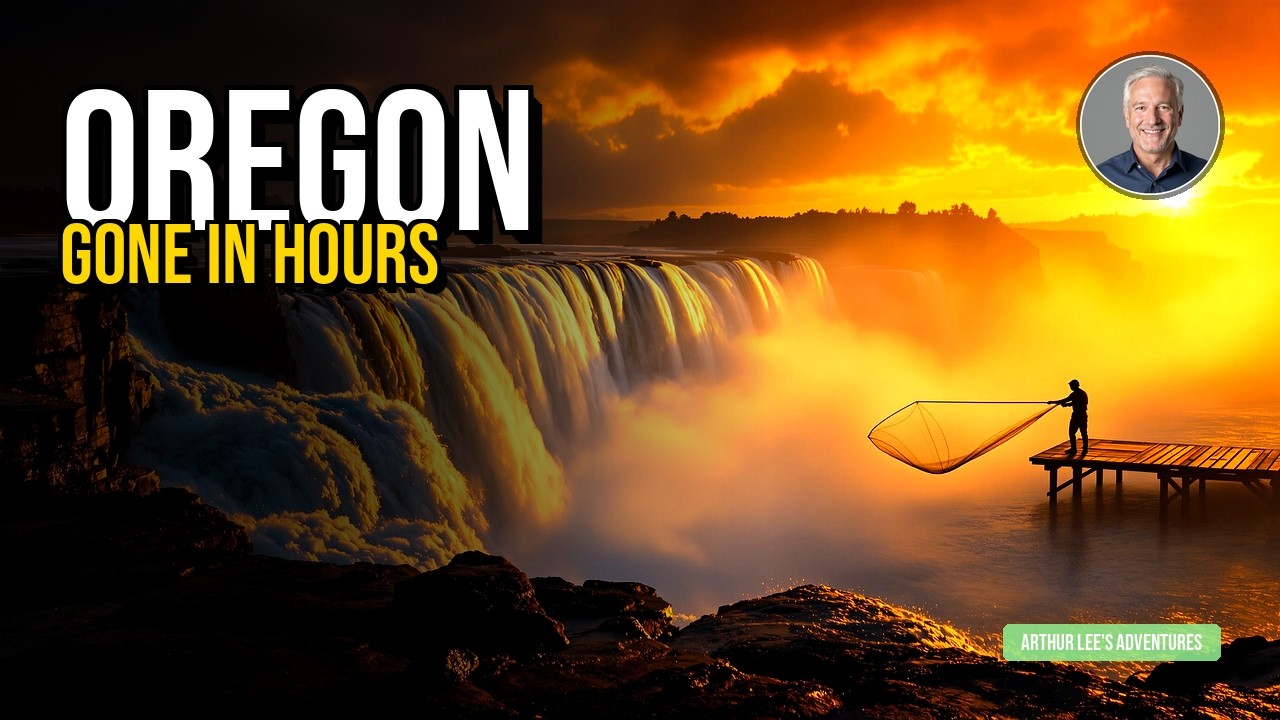
On March 10, 1957, the U.S. Army Corps of Engineers closed the gates of The Dalles Dam on the Columbia River. The reservoir behind the dam began to fill. By evening, Celilo Falls — the great cascade where the Columbia dropped over a basalt shelf in a roar audible for miles — was underwater.
Celilo had been a fishing site for at least eleven thousand years, possibly longer, making it among the oldest continuously inhabited places in North America. The Columbia’s salmon runs brought Indigenous nations from across the interior plateau — Yakama, Warm Springs, Umatilla, Nez Perce, among others — to fish from wooden platforms extending over the falls, to trade, to gather. It was a place with an economy, a diplomacy, and a social life of its own, sustained by the river’s extraordinary productivity.
The federal government paid the affected tribes approximately $26.8 million in compensation — a figure that, however large it may have appeared in 1957, represented a fraction of the falls’ cultural and economic value, and that had no mechanism for compensating for what could not be assigned a dollar amount.
Photographs taken on March 10, 1957 show tribal members standing on the banks as the water rose. Accounts from that day describe people weeping. One witness recalled that the falls did not disappear dramatically — the water simply came up, and the sound faded, and then there was a lake where the river had been.
The dam generates power. The salmon runs that depended on the falls as a migration corridor were functionally destroyed. The tribes whose treaty rights guaranteed them access to the fishery found those rights guaranteed to a place that no longer existed.
The Pattern Beneath the Stories
Taken separately, these events read as curiosities — the whale, the balloon bomb, the commune, the dam. Taken together, they describe something more coherent.
Oregon’s history is structured by decisions about who gets to be in a place, who gets to use it, and who gets to decide. The exclusion clause decided that Black residents did not belong. The alien land laws decided that Chinese and Japanese immigrants could not own what they worked. The flooding of Vanport scattered a community that had formed around wartime necessity and then become inconvenient. The drowning of Celilo Falls extinguished eleven thousand years of Indigenous presence beneath a reservoir created for the benefit of a regional power grid.
Tom McCall’s Beach Bill runs against this pattern — a decision that something should belong to everyone, permanently, that no private interest should be able to close a shoreline that had always been open. It is the exception that clarifies the rule.
The question that Celilo Falls poses — who has the right to decide when a place is sacrificed for progress, and what counts as progress, and who counts as a stakeholder — has not been answered. It is being asked right now about rivers across the American West, about salmon runs, about dam removal, about whether the accounting done in 1957 was complete.
Oregon is not a weird state. It is an honest one, if you look at the right documents. The strangeness is not the whale or the commune. The strangeness is how much history fits inside a single afternoon.
*The debate question for this episode: The Dalles Dam brought cheap electricity