The Richest City in Texas: How One Night in 1900 Erased Galveston’s Golden Age
Before Houston was anything more than a muddy inland town, Galveston ruled Texas — and its fall remains the deadliest natural disaster in American history.
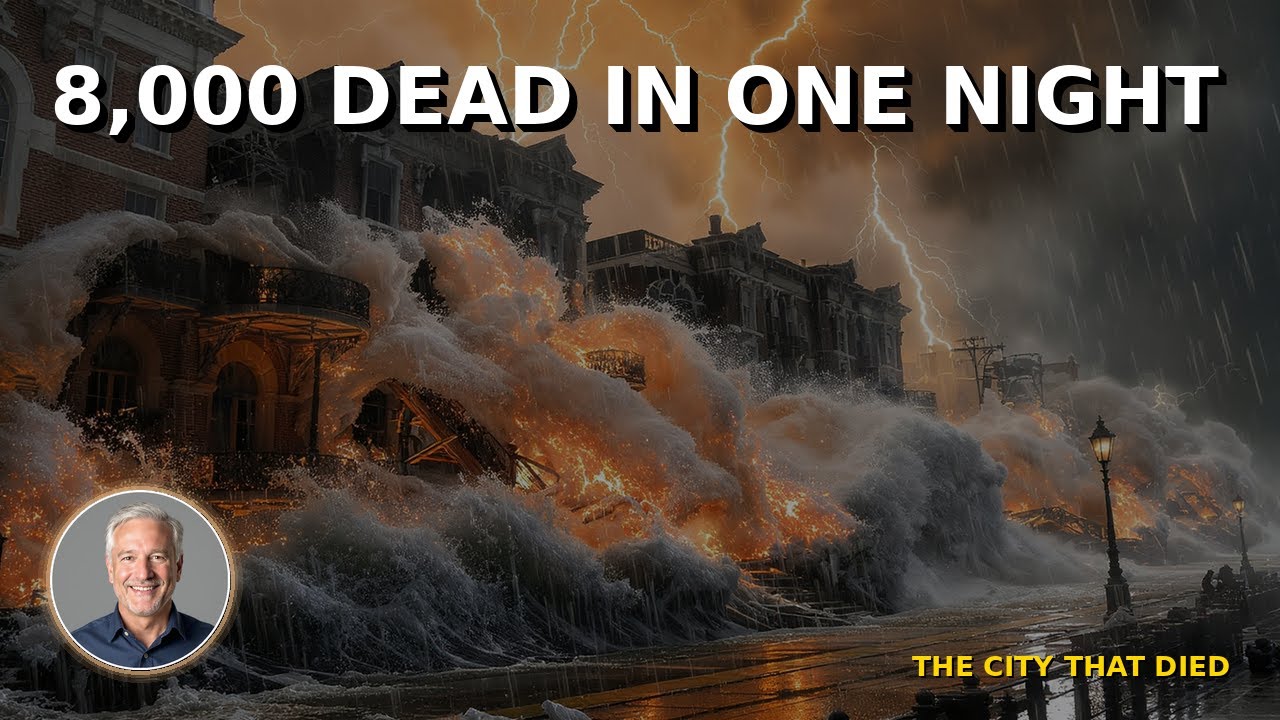
On the morning of September 8, 1900, Galveston, Texas was the wealthiest city in the state, one of the busiest ports in the nation, and by many measures the cultural capital of the American Southwest. By midnight, somewhere between 8,000 and 12,000 people were dead. The exact number has never been determined — and that uncertainty alone tells you something about the scale of what happened.
What followed the storm was, in some ways, more horrifying than the storm itself. The bodies were everywhere. There were simply too many to bury. Workers loaded the dead onto barges and pushed them out into the Gulf of Mexico, hoping the sea would take them. The sea refused. Day after day, for weeks, the tide brought the bodies back to shore. The city eventually built funeral pyres at street corners across the island. The smoke hung over Galveston for the better part of a month.
This is the story of how nature dismantled a city that had taken sixty years to build — and how that single night handed the future of Texas to Houston, permanently.
The Wall Street of the Southwest: What Galveston Was Before the Storm
To understand what was lost in September 1900, you have to understand what Galveston had become since its formal founding in the republic of Texas in 1839.
By the late 19th century, Galveston was processing more cotton than any port in the United States. It was the financial center of the entire Southwest, home to the first electric lights in Texas, the first telephone exchange, the first golf course, the first country club. The per-capita wealth of Galveston in 1890 was extraordinary — some historians have placed it among the wealthiest cities in the entire country by that measure.
The money was visible in the architecture. The Gilded Age mansions that lined Broadway Boulevard — many of which still stand today, survivors of the storm by sheer structural luck — announced a city that expected to keep growing. Henry Sealy, one of the island’s banking and real estate titans, built a home of such extravagance that it anchored an entire neighborhood of ambition. Walter Gresham, a railroad attorney and political heavyweight, constructed what locals called “the Bishop’s Palace,” a Romanesque Revival fortress of limestone and granite that stood as a symbol of Galveston’s permanence.
Financiers like Isaac Kempner ran enterprises that stretched across the region. Kempner’s family, who had arrived as merchants and built a cotton trading and banking empire, represented the kind of multi-generational wealth Galveston had accumulated. This was a city that believed, reasonably, that it would define Texas for the next century.
The one thing Galveston lacked — the thing it had always quietly worried about — was elevation. The island sat barely eight feet above sea level at its highest point. Everyone knew the Gulf was right there. They simply believed, or chose to believe, that catastrophe could be weathered.
Isaac Cline and the Forecast That Failed
The man most directly blamed for failing to warn Galveston about the approaching storm was Isaac Cline, chief meteorologist for the U.S. Weather Bureau’s Galveston office. Cline is a complicated figure in this story, and history has not been entirely fair to him.
In 1891, Cline had published an article in a meteorological journal dismissing the possibility that a hurricane could seriously damage Galveston. His argument was largely geographic — he believed the shape of the Texas coastline would weaken any incoming storm. It was a confident, professional opinion, and it was catastrophically wrong.
On September 8, 1900, as the barometer fell and the Gulf water began creeping into the streets from the south, Cline did ride through the beach neighborhoods on horseback, warning residents to move inland. He later claimed to have saved thousands of lives with these warnings. His critics, and there were many in the years that followed, argued that the official warnings came too late and were insufficiently urgent. The Weather Bureau had also, notably, dismissed Cuban meteorologists who had been tracking a dangerous storm system with considerable accuracy.
What is not in dispute is the result. The storm surge — walls of water reaching 15 feet in some areas — swept across the island from south to north. There was nowhere to go. Buildings collapsed and became deadly debris fields carried on the surge. Entire neighborhoods vanished. Churches packed with people seeking shelter became death traps when their roofs failed.
Cline survived. His brother survived. Thousands did not.
The Aftermath: When the Dead Came Back
The immediate aftermath of the Galveston hurricane confronted survivors with a logistical and psychological horror that has few parallels in American history.
The bodies numbered in the thousands — estimates range from 6,000 at the conservative end to 12,000 at the upper bound. Many were never identified. Many were never recovered. In the days following the storm, workers under the direction of city authorities loaded corpses onto barges and transported them miles offshore into the Gulf of Mexico, weighted with whatever was available.
It did not work. The currents and tides pushed the bodies back to shore. Workers would arrive at the beach in the morning to find the dead had returned overnight. This continued for weeks.
The city’s response was grimly practical: burn them. Funeral pyres were constructed throughout the wreckage of the city. The fires burned for weeks. Survivors who lived through the storm later said the smell — of burning and decay — was something they carried with them for the rest of their lives.
Clara Barton and the Largest Red Cross Relief Mission in History
Clara Barton was 78 years old in September 1900. She had founded the American Red Cross in 1881, had served as a nurse during the Civil War, and had led relief efforts after disasters across two continents. And yet Galveston was, by her own account, the largest relief operation she had ever overseen.
Barton arrived in Galveston in mid-September, just days after the storm. The scope of the operation she organized — coordinating food, clothing, medical care, and construction materials — was unprecedented. She spent five weeks on the island, personally supervising distribution efforts and working to restore some basic framework of civilized life to a city that had been reduced to rubble and grief.
It was among her last major field operations. She was removed from leadership of the Red Cross in 1904, partly due to criticism of her management style. But in Galveston in 1900, she was exactly what the city needed: experienced, tireless, and utterly unsentimental about the scale of the work.
The Engineering Response: How Galveston Tried to Save Itself
What Galveston did after the 1900 storm was genuinely remarkable, and it deserves more attention than it typically receives in popular accounts.
The city built a seawall. Beginning in 1902, engineers constructed a concrete barrier along the Gulf-facing shore — initially 17 feet high and 16 feet wide at the base. It was eventually extended to 10 miles in length and has since been raised and reinforced multiple times. The Galveston Seawall is still there, still functioning, still walked by tourists who rarely think about what it cost or why it exists.
More extraordinarily, the city raised itself. Through an engineering process called grade raising, engineers pumped dredged sand from the Gulf floor beneath the entire city, elevating it by as much as 17 feet in some areas. Houses were lifted on jacks while fill was pumped underneath. This process took years and required the temporary relocation of utility infrastructure across the entire island. It remains one of the most ambitious urban engineering projects in American history.
But engineering, as it turned out, could not solve an economic problem.
How Houston Stole Texas: The Rivalry That Shaped a State
While Galveston was rebuilding its seawall, Houston was quietly, deliberately, and ruthlessly positioning itself to become what Galveston had been.
Houston interests had long resented Galveston’s dominance. The island city controlled the port, the railroad connections, and the banking relationships that the inland city depended on. After the storm, Houston’s business community moved quickly. They lobbied successfully for federal investment in deepening the Houston Ship Channel, a project that had been discussed for years but now gained urgency and political support that Galveston could no longer resist.
When the Spindletop oil field blew near Beaumont in January 1901 — just four months after the hurricane — the new petrochemical economy that would define Texas for the next century organized itself around Houston, not Galveston. Houston had railroad connections, land for refineries, and investors who were looking for a future rather than a recovery.
By 1910, Houston had surpassed Galveston in population. By 1930, the comparison was embarrassing. The “Wall Street of the Southwest” was now a mid-sized port city living partly off tourism and partly off memory.
What This Story Tells Us About Cities, Disasters, and Economic Power
The Galveston story repeats itself across history with uncomfortable regularity. Natural disasters rarely simply destroy — they accelerate economic shifts that were already underway, and they reveal which cities have the political relationships and geographic advantages to attract reconstruction investment.
New Orleans after Hurricane Katrina in 2005 offers a direct parallel. The physical destruction was catastrophic, but the longer-term damage was the acceleration of population loss and economic activity to the suburbs and to other Gulf Coast cities that had been competing with New Orleans for years. Detroit’s decline was not caused by one event but was crystallized by a series of crises that accelerated existing trends.
Galveston had a structural vulnerability — its island geography — that its Gilded Age prosperity had allowed it to ignore. The hurricane did not create Houston’s opportunity; it simply removed the obstacle. Houston was already better positioned for the oil economy, the railroad economy, and the sheer physics of growth that favors inland cities with expandable land.
Isaac Kempner and other Galveston elites stayed and rebuilt, and they deserve credit for that. The seawall was real. The grade raising was real. But they could not rebuild the confidence of capital, which had found somewhere else to go.
The Question the Story Leaves Open
Galveston today is a place of considerable charm — its Victorian architecture, its seawall promenade, its position as a weekend destination for Houston residents — and it is easy to see it as a place that found an identity after catastrophe. But the harder question is whether that identity was ever really chosen.
Could Galveston have reclaimed its dominance after 1900? Could a different set of political decisions, a different alignment of investment, a faster rebuilding effort have kept Houston in Galveston’s shadow?
Most historians who have studied the question closely are skeptical. The structural advantages that favored Houston — expandable land, central railroad geography, proximity to the oil fields that were about to transform the American economy — would have asserted themselves eventually. The hurricane may have made the outcome more sudden and more dramatic, but the direction was probably already set.
What the 1900 storm did, irreversibly, was eliminate the possibility of finding out.
The Galveston hurricane of 1900 remains the deadliest natural disaster in United States history. An estimated 8,000 to 12,000 people died in a single night. The seawall built in its aftermath still stands. The city it was meant to protect never fully recovered the position it held the morning before the storm arrived.